There are several tiers of wines that can legitimately and confidently wear the name tag: HELLO MY NAME IS: Cult Napa Cabernet at any party they happen to attend. The top tier is populated by Screaming Eagle, a single wine that practically invented the phrase “cult Cabernet.” Below the hysterically unattainable pricing and scarcity of the Eagle, however, there are several wines which clearly deserve the moniker, and which tend to get consumed a bit more often, if only because in doing so, a wine lover isn’t drinking a the equivalent of a San Francisco monthly mortgage payment.
That’s not to say I can really afford to own or drink a bottle of Colgin Cellars wine whenever I want to, but when friends offer the opportunity, I’m happy to take advantage of the opportunity.
Colgin Cellars was started in 1992 by Ann Barry Colgin, a fine art specialist who made her reputation and fortune in the fine art auction world, along with her (now ex) husband, Fred Schrader. During her career as an auction consultant and fine art broker, it’s no surprise that she gained exposure to the collectible wines that so often are appreciated by the same connoisseurs of fine art. Colgin’s passion for wine was nurtured along with her knowledge and reputation in the art world to a point where it was no longer enough to simply drink a great bottle with friends. And so, with the selectivity and discernment that marked her appreciation for the finest art in the world, Colgin set out to create one of the finest wine brands in the world. No mean feat, to be sure, but Colgin’s success is undeniable no matter what criteria are used to measure it. From critical acclaim, to market prices, to the the devotion of collectors everywhere, Colgin wines are among the most sought after in Napa.
Just like fine art, great wine is a combination of raw materials, talent, and passion, and all three are collected in abundance at Colgin Cellars. The winery sources grapes from select sites in and around St. Helena, all of which are managed impeccably by one of Napa’s most famous names in vineyard management (and winemaking), David Abreu. Wineries most often trade on the cachet of the names of their winemakers, but Abreu is one of a few select vineyard managers whose name seems to virtually guarantee a blockbuster product.
The winemaking team at Colgin has included superstars Helen Turley and Mark Aubert, but in February of this year the role of head winemaker was handed to the less well-known Allison Tauziet, who up until then had played the role of assistant winemaker under Aubert after joining the team in 2005. Tauziet, a graduate of U.C. Davis began her career as resident enologist, and then spent a solid five years as assistant winemaker, at the iconic Far Niente winery. In addition to Tauziet and the considerable winemaking expertise of Abreu, Colgin also employs consultant Alain Raynaud, a well known name in Bordeaux. Among other influences in the world of Bordeaux, Raynaud has served as winemaker for La Fleur De Gay and La Croix De Gay in Pomerol, Chateau Quinault in St. Emillion, and managed operations at Chateau Lascombes in Margaux.
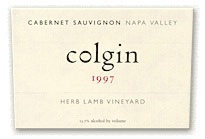
This particular wine comes from the Herb Lamb Vineyard, a site for which Colgin has had a long-term growing contract since her very first vintage. Owned by Jennifer and Herb Lamb, this 7.4 acre hillside that sweeps up the mountainside behind St. Helena. Originally a scrubby, forested patch of land, it has been massaged into terraced plots of Cabernet Sauvignon that were planted in the early 1990s, with some more recently replanted in 1999 and 2000. These northeast facing terraces benefit from the coolness of their elevation above the valley floor, but also from their generous sun exposure, making for very long, even growing periods that make Napa’s hillside fruit some of the most sought-after (and expensive) in California.
This wine is the product of the spectacular 1997 vintage, which along with the 1994, was widely acknowledged (without any of the irony and cynicism that accompany such pronouncement these days) as one of the best in decades. A long growing season with warm but not scorching weather resulting not only in a perfect harvest but one in which crop levels were significantly higher than normal. The grapes for this wine were hand picked before sunrise and meticulously sorted cluster-by-cluster before going into the destemmer. The berries coming out of the destemmer were then sorted by hand again, with anything less than perfect berries being removed before the cold soak and extended maceration in stainless steel tanks. The wine was then put in French oak barrels to undergo its secondary (malolactic) fermentation over several weeks in a warmer-than-usual cellar, a technique which the estate believes adds complexity to the wine. After spending at least 18 months in barrel it is bottled without fining or filtration. Only about 150 cases of this wine are made each year, and I suspect that even fewer were made in 1997.
Tasting Notes:
A lightly cloudy medium ruby color with hints of orange at the edges, this wine has an entire forest in its nose, with a gorgeous bouquet of eucalyptus, mint, cedar, and pine aromas layered over a hint of smoky meat. In the mouth the wine is silky and sensuous in texture with flavors of mint, cherry, and black raspberry that are riddled with finely veined, dusty tannins. This is one of those wines for which, if you’re not careful about paying attention to when you swallow, you cannot tell when the sensations in your mouth have moved from tasting the wine to tasting the finish. The wine has incredible length and presence in the mouth, remaining for minutes afterward with traces of sandalwood incense and, wait, is that joy that I’m tasting? It must be.
Food Pairing:
With a wine like this, I think it is best to just put it in your mouth, and close your eyes. Enough said. But if you actually had the presence of mind to be able to operate a fork after taking a sip of this wine, you might fill it with crispy pork belly.
Overall Score: 9.5
How Much?: $750 will get you a bottle from retailers.
This wine is available for purchase on the Internet.


