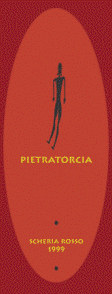
The phrase “wine country” generally evokes a wide variety of mental images, largely derived from each person’s individual experience in such landscapes. My mental image is most certainly the golden hills of Sonoma County from my summers spent as a child in Northern California, followed closely by the lush green hills of Tuscany in the springtime.
I’d venture to say one of the least common pictures of wine country would be a tiny volcanic island, growing grapes within a stone’s throw of the Mediterranean and interspersed with geysers and mud baths. Leaving aside the coincidence that Napa valley has its own geysers and mud baths, a nearly tropical isle is certainly not the likely site of a winemaking history that goes back more than 3000 years.
Unless of course you’re speaking about Italy — where people have grown grapes pretty much everywhere they possibly could since as long as people knew what grapes actually were.
The island of Ischia, just off the coast of Naples in the Tyrrhenian Sea was probably first settled by a combination of ancient Greeks, Phoenicians, and Etruscans in about the 8th century BCE, and it’s likely that even then, enterprising souls were seeking out patches of ground where the native volcanic rock was broken enough to allow a vine to thrive.
These early vintners were clever folks, and as those times required, ingenious in their use of whatever materials lay at hand. They had a lot of rocks on this 46 square kilometer island, and the volcano was always making more. So it wasn’t long before someone realized that the porous basalt and tuff rocks made pretty good tools for crushing grapes, giving rise to a tool named a pietratorcia.
Nobody uses them anymore, of course, but the name has been taken up by the island’s primary wine producer. Pietratorcia is a relatively small winemaking operation, begun by a group of younger entrepreneurs who were interested in reviving the island’s mostly defunct winemaking history. They purchased and refurbished an old property, selectively replanting about 20 acres of its vineyards and overhauling the cellar with modern winemaking equipment. The owners have walked a fine line between tradition and modernity, choosing to use advanced winemaking processes, while preserving the heritage of their property (for instance, not disturbing the well established rabbit warren in the vineyards).
This wine itself is an unusual blend of old and new world, both in its composition and style. Made with a combination of 30% Syrah, 15% Grenache, 40% Aglianico, and 15% Piedirosso, in a cheeky moment you might call this wine a Spaghetti Rhone Ranger. The grapes are grown in exceptionally tight spacing in the vineyard, and the Aglianico and Piedirosso vines are some of the island’s oldest producing vines. After hand harvesting and destemming, the grapes undergo an extended maceration (a soaking process to provide extended contact between the juice and the skins), and are fermented at low temperatures in steel tanks to preserve the aromatic qualities of the wine. The wine is aged on the lees (sediments left over after pressing the grapes) in oak barrels for 15 months, with frequent stirring or batonnage, a process which mixes the lees with the wine at regular intervals. The wine ages for an additional year in the bottle before release.
Pietratorcia makes several wines in addition to this red, including several white wines that utilize grape varieties like Biancolella and Forastera, which, while not indigenous to the island itself, are rarely found anywhere else.
Tasting Notes:
Deep purple in the glass this wine has an incredibly aromatic nose that quite simply bowls you over from the first scent of its smoky, oaky plum and spice scents. In the mouth it is smooth and silky with light velvety tannins that wrap around flavors of redcurrant, rosehips, plum, and earth with notes of sandalwood and vanilla on the long, expansive finish. This is clearly a modern styled wine, with significant oak influence, but it is impossible not to love the truly unique combination of flavors that pair beautifully with meats, and will likely last a good long while in the bottle.
Food Pairing:
I can’t recommend this wine more highly than with a dish of roasted lamb chops or braised veal cheeks.
Overall Score: 9
How Much?: $50
This wine is unfortunately quite difficult to find for purchase online. Talk with your local Italian specialist and see if they can get you some.


