These are troubled times for wine growers around the world. If it's not too hot, it's too cold. If its not too rainy, its the biggest drought on record for centuries. Maybe there's somewhere that grape growing is always idyllic with no problems (Thailand? oops, no, they have tsunamis..) but I haven't heard of it.
Some of the most severe and vexing problems facing modern winemakers are the ones that seem to come from out of left field (no pun intended). In the America West it's the glassy winged sharpshooter which rears its ugly miniscule head every once in a while; in South Africa it's massive flocks of starlings that eat a lot of the grapes; in Italy it's biblical plagues of locusts devouring fruit.
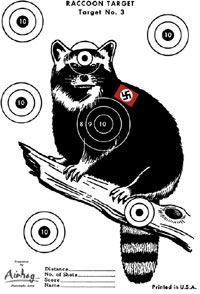
And now, the perfect villain. A black mask, a swastika in its past, and a penchant for ripe Riesling. The Nazi Raccoon.
Once you stop chuckling (I still erupt into giggles every time I read the headline), I'll tell you that the raccoons were introduced to Germany by Nazi air force chief Hermann Goering in 1934 to 'enrich' Germany's fauna. They have no natural predators, are extremely adaptable to both urban and rural settings, and they breed like rabbits.
Now, apparently thousands of them have descended upon certain areas of vineyard land in Brandenburg and have literally ruined the harvest. Tough times for grape growers indeed, and ultimately no laughing matter, as people's livelihoods are on the line. But why did they have to be Nazi raccoons... ?
Digg it! -
Add to del.icio.us -
Add to Stumbleupon -
Add to Reddit
Iris
wrote:I tried to find something in German newspapers about those racoons - they were really principally imported in 1934 to enlarge the Targets for hunters... but also to start fur-production.
It's from one of these farms, that some animals escaped after a bombardment in 45 .
That's how the whole "pest" started.
Apparently, they haven't come to the South of France yet. It would be interesting to see, how they would cohabitate with our local wild boars, badgers, foxes and other wild animals, who are all very greedy in our wines.
It's always "funny" to talk about these invasions to people who have never seen a wine field after those "visits" - it looks very much like after the passage of a harvesting machine. But as you say: for us, no laughing matter, when we see our livelihood on the line.
Mariella
wrote:I also tried to find something more on the internet and found a German blogger, www.winzer.blogg.de, with lots of information. It looks to me like a message completely blown out of proportion! Hope you can read Dutch, I wrote about it on my blog.
Mariella
wrote:Sorry, it's winzer.blogg.de
Lenn
wrote:When I read your post title, I thought it was a joke! Crazy...and amzazing how well vinters do world wide given the pests/problems.
On Long Island, not only do we risk exposure to hurricanes (and remnants) each year around harvest, we are on the migratory path for many species of birds...and we have DEER...though I think they are native...not nazi.
Melanie
wrote:I haven't stopped giggling at this title. heh. Further proof that if human beings would just leave things alone then we wouldn't end up with problems down the line.
Mithrandir
wrote:I kind of wonder if there isn't some way to train dogs or some other natural predator to defend a vineyard from animal incursion.
The re-introduction of wolves into Yellowstone has had a dramatic positive effect on the elm population. The elms used to be terribly over-browsed by the local elk, but with the re-introduction of the wolves, the elk tend to stay away from the edges of forests, where wolves might be lurking. For the first time in decades, there are new saplings.
So it's not necessary to mount an absolute defense. Just to make deer, raccoon and bird incursions risky.
One could probably also get some benefit from spreading predator urine and feces around the vineyard. I know some zoos do a nice side business in selling big cat excrement for this sort of thing. I don't know how effective that would be against raccoons though.
Geoff Smith
wrote:The solution is simple. Simply declare open season on the raccoons, and the resulting pelts could be offered at the Fess Parker winery as coonskin caps!
This story is interesting: it reminds me of the famous Avery Island nutria program which has resulted in enormous amounts of nutria running amok in Louisiana.
Cheers,
Geoff
Bill Larsen
wrote:Can someone e-mail me a good clear picture of the Nazi Racoon Target #3 pictured above? I would just love it for target practice. Thanks loads.
Vinography Unboxed: Week of March 10, 2013 Bilancia Wines, Hawke's Bay, New Zealand: Current Releases Vinography Images: Across the Valley Drinking Off the Grid Vinography Images: Behind the Gate Vinography Unboxed: Week of February 24, 2013 The Best of Napa's 2011 Cabernets: Tasting at Premiere Napa Valley Great Dirt is Not Sentimental: Ted Lemon on Terroir Vinography Images: Vineyard Bowl 11th Annual Pinot Noir Summit: March 16th, San Francisco
Masuizumi Junmai Daiginjo, Toyama Prefecture Wine.Com Gives Retailers (and Consumers) the Finger 1961 Hospices de Beaune Emile Chandesais, Burgundy Wine Over Time The Better Half of My Palate 1999 Királyudvar "Lapis" Tokaji Furmint, Hungary What's Allowed in Your Wine and Winemaking Why Community Tasting Notes Sites Will Fail Appreciating Wine in Context The Soul vs. The Market 1989 Fiorano Botte 48 Semillion,Italy