Call me curious, or just call me a big geek, but I get really excited when I get the opportunity to taste the wines from somewhere I've never tasted before. So when the invitation came in to attend an event focused on the wines of Brazil, I jiggled some appointments around and snuck out of work for an hour last week and spent some time on my "other job" -- the intrepid global wine explorer.
My experience with and knowledge of Brazilian wine before this tasting amounted to a big fat zilch -- never tasted it, never talked about it, never read about it.
Of course, in the back of my head, I knew Brazil was a wine producing country. A good portion of the country dips
down into the latitudes of places like Mendoza and Salta, two great wine producing regions of Argentina, but I knew little about the topology, climate, and history of this area of the country.
It turns out that, not unlike Argentina, Brazil has a relatively long history of winemaking (for the New World) thanks to the primarily Italian immigrants that settled the southern part of the country in the mid 1800s. Like many immigrants everywhere, they brought grapevines and a tradition of wine -- both a cultural custom and a welcome respite for a difficult life. The wine craft and culture of Brazil remained essentially a local agrarian village industry for the next thirty years, with only a modest amount of wine leaving the region to elsewhere in the country.
It wasn't until the mid 1960s that the industry began to seriously expand and invest in the modernization that would be required to compete on the global market. Family wineries began to send their children to universities to study oenology and viticulture, and new vineyard sites began to be selected based on soil science and micro-climactic measurements. Slowly the industry grew up.
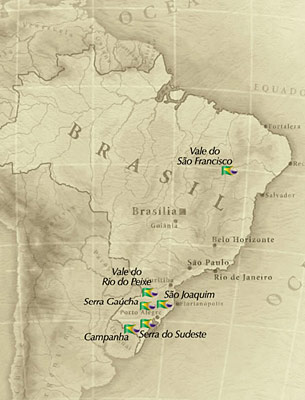
In 1998 the Brazilian Wine Institute was created. Today the country has nearly 30,000 acres under vine and produces about 45 million liters (5 million cases) of wine per year, fairly equally split between red and white varieties. The vast majority of that wine production (90+%) still takes place in an area known as Serra Gaúcha which is at around 29 degrees south latitude, roughly parallel to Mendoza Argentina and sandwiched between Uruguay and the Atlantic Ocean.
Serra Gaúcha is a hilly plateau at about 640m/2100 feet above sea level and is planted primarily with red and white Bordeaux varieties, plus some Chardonnay, Muscat, Pinot Noir, and Gamay. Annual temperatures range from 12C/54F to 22C/72F, and the region gets about 68 inches (!) of rain per year.
In addition to Serra Gaúcha, additional vineyard development is taking place in a region called Vale do São Francisco, which is a very interesting sounding wine region. Located in the Northern part of Brazil, the flat plains of this are at a mere 9 degrees South latitude, and are extremely dry. The warm climate and the artificial irrigation required to grow vines allows two harvests per year.
Of course, that's interesting stuff, but all academic. Good background, but what matters, of course is whether the wine is any good, right?
And generally, I'm sad to say, it is not.
Many of the sixty or so wines I had the opportunity to taste at this event weren't very good. But there were a few that were decent -- decent enough to prove that it certainly is possible to make quality wine in the country. Whether or not it is possible to do it in quantities and at prices that would allow Brazil to carve out a little bit of the international export market I don't have the information to say, and which I am certainly not qualified to judge.
So while Brazilian wine must generally be avoided by those looking for predictably high quality wines, those like myself that are willing to experiment and explore will doubtless find gradually improving wines coming from the land of Carnaval.
WINES SCORING BETWEEN 8.5 and 9
2004 Casa Valduga Brut Premium Sparkling Wine. $17
WINES WITH A SCORE AROUND 8.5
2002 Boscato Reserva Cabernet Sauvignon. $40
2006 Casa Valduga Premium Chardonnay. $15
2002 Don Laurindo Gran Reserva Bordeaux Blend. $105
2005 Don Laurindo Malbec. $45
2004 Miolo Quinta Castas Portuguesas Red Wine. $23
2004 Salton "Talento" Red Blend. $25
2006 Salton Volpi Chardonnay. $13
WINES SCORING BETWEEN 8 and 8.5
NV Mioranza Sparkling Wine Brut. $20
2005 Mioranza Cabernet Sauvignon. $15
2004 Salton "Desejo" Red Blend. $29
2007 Salton "Flowers" Demi Sec White Wine. $7
WINES WITH A SCORE AROUND 8
2005 Boscato Cabernet Sauvignon. $21
2006 Brazilian Soul Chardonnay. $9
2005 Don Laurindo Cabernet Sauvignon. $35
2006 Miolo Reserva Chardonnay. $12
2004 Miolo Reserva "Terroir" Merlot. $45
2006 Mioranza Chardonnay. $15
2005 Mioranza Merlot. $15
NV Mioranza Moscatel Sparkling Wine. $18
2004 Pizzato "Concentus" Red Blend. $25
2004 Pizzato Merlot. $15
NV Marson Brut Sparkling Wine. $15
WINES SCORING BETWEEN 7.5 and 8
NV (Aurora) Conde de Foucauld Moscatel Sparkling Wine. $10
2004 Casa Valduga Duetto Cabernet Sauvignon/Merlot. $14
2005 Don Laurindo Merlot. $35
NV Geroges Aubert Extra Brut Sparkling Wine. $16.50
NV Geroges Aubert Prosecco Brut Sparkling Wine. $12
NV Miolo Brut Sparkling Wine. $15
2004 Miolo "Lot 43" Red Blend. $35
2007 Pizzato Chardonnay. $15
2005 Pizzato "Fausto" Cabernet Sauvignon. $11
2005 Salton Volpi Cabernet Sauvignon. $13
WINES WITH A SCORE AROUND 7.5
2005 Boscato Reserva Merlot. $25
2004 Casa Valduga Cabernet Franc Premium. $14
NV Georges Aubert Moscatel Sparkling Wine. $12
2005 Marson Famiglia Chardonnay. $15
2002 Marson "Gran Reserva" Cabernet Sauvignon. $15
2004 Pizzato Cabernet Sauvignon. $15
2005 Salton Volpi Merlot. $13
WINES WITH A SCORE AROUND 7
2006 Marson "Vale da Ferradura" Red Blend. $10
2005 Panceri Merlot. $6.50
2004 Pisani e Panceri Cabernet Sauvignon. $18.50
2007 Pizzato Merlot Rosé. $11
WINES SCORING BETWEEN 6.5 and 7
2004 Aurora Cellars Proprietary Red. $11
2004 Casa Valduga Gran Reserva Cabernet Sauvignon. $32
NV Geroges Aubert Demi Sec Sparkling Wine. $12
2006 Miolo Reserva Pinot Noir. $12
2004 Panceri Cabernet Sauvignon. $6.50
WINES WITH A SCORE AROUND 6.5
2005 Brazilian Soul Merlot. $9
2002 Marson Famiglia Cabernet Sauvignon/Merlot. $15
WINES WITH A SCORE AROUND 6
2004 Aurora Cellars Merlot. $11
2004 Casa Valduga Merlot Premium. $15
2005 Georges Aubert Cabernet Sauvignon. $17
2004 Marson Reserva Merlot. $14
2005 Brazilian Soul Cabernet Sauvignon. $9
Digg it! -
Add to del.icio.us -
Add to Stumbleupon -
Add to Reddit
Listed below are links to blogs that reference this entry: The Best of Brazilian Wine: My First Taste and Impressions.
TrackBack URL for this entry: http://www.vinography.com/MT/mt-tb.cgi/7065
Brian
wrote:Give 'em time. Heck, you copuld probably say the same thing about most California supermarket-level wine in the saem price range :)
Dean Tudor
wrote:I attended a leaner trade version in Toronto, Canada. Miolo was once available in Canada several years ago, but the agent went out of business due to a lack of business...Rolland is a consultant to Miolo. Most Brazilian wines show a distressing lack of terroir. They are basically just wines made from cab, from merlot, for chardonnay, etc. The grapes could be from anywhere: some styles alternate from year to year. One vintage or winery could be doing a North American juicy style, and the next time the style could be Euro. One region in Brazil can even deliver TWO harvests a year...Here's more, from my notes --
* Miolo Merlot Terroir 2005: this was a wine to savour and to cellar, $45 US retail, good depth but needing time. Michel Rolland is an adviser to the winery.
* Mioranza Cabernet Sauvignon 2005: $15 US, spicy fruit, good oaking from six months in French oak.
* Casa Valduga Cabernet Sauvignon Gran Reserva 2004: $32 US: hard oak, red fruit, still needed time.
* Pizzato Concentus 2004: $25 US, very good concentration, one of my top picks of the afternoon. It was 40% merlot, 40% tannat, and 20% cabernet sauvignon, barreled in 50 – 50 French and US oak.
* Panceri Pisani and Panceri Gran Reserva Cabernet Sauvignon 2004: $18.50 US, and a bargain. Grapefruit, red fruit, oak tones, higher acid on the finish for food. French oak.
* Boscato Gran Reserva Cabernet Sauvignon 2002: $80 US. Gold medalist, oaky, plummy, saturated, delivers the goods with flavours, but pricey.
* Don Laurindo Gran Reserva 2002: $105 US. Bordeaux-styled blend, only made in special harvests (1999, 2002, 2005). New French oak dominates.
Other wines in the show included a variety of chardonnays (the more it cost, the better it tasted) and sparkling wines. The sparklers were good value, especially the Panceri Espumante Moscatel for $6 US. In the reds, I enjoyed the Casa Valduga Cabernet Franc 2004 ($14US) and their Duetto Cabernet Sauvignon/Merlot 2004 ($14US), Don Laurindo Reserva Malbec 2005 ($45US), Miolo Lote 43 2004 ($35US) with its 50-50 merlot and cabernet sauvignon done up in US oak, and both the Pizzato Reserva Merlot 2004 and Cabernet Sauvignon 2004 ($14 apiece).
Golly
wrote:I've seen Brazilian wines at trade shows, the promotions are exciting and the enthusiasm is infectious, but it's a long way to ship ordinary wine. I don't think there's a serious distributor of Brazilian wines in the UK yet, but the emphasis is on the 'yet'.
Breno Raigorodsky
wrote:I'm about to build a brazilian's red wine Simposium, here, in Sao Paolo. Triyng to do it at first semestre of 2008, in you are invited to come as observer!
Try Aurora C.Sauvignon Millesime and the very charming wine from Villa Francioni (São Joaquim), Familia Francioni, perhaps the best red wine ever made in Brazil
Gilberto Pagua
wrote:Is large list of wines you tried.
I see severals Miolo in the list and this is a good example of the quality diverity of the brazilian wines.
We live in Venezuela and my wife works for a Brazilian company and every time she goes I ask for a bottle.
So far I only have a review of one of this bottles and agree with you that the quality is regular but the have a good future.
You can see the review in this URL.
http://www.antociano.net/blog/index.php/2007/05/adega-do-vale-2003/
Of course is in spanish.
Regards,
Elton
wrote:OT: Where did that map image come from? I'd like a bigger version...
Abilio Rentes
wrote:Well, all these comments mean the continous quality increase or the Brazilian Fine Wine and mainly, also, concerned to the "Small Wineries", too, that make the difference !!!!
Cheers !!!
Abilio
Felipe Méndez
wrote:I'm a declared Brazil fan. I love Brazil. If I had to choose a place to live, anywhere in the world, it would be somewhere in Santa Catarina or Rio Grande do Sul. The lifestyle, the football passion (I love football, aka Soccer), the joy in the air, the charming weather, the best sea ever and undobtedly the beautiest women alive are there.
But the wine is lousy.
I attended a big Brazil tasting once, maybe four years ago. Some of the big names were there: Valduga, Miolo, Laurindo. I don´t remember the exact labels, I'm afraid. But it all ended up in the pipe. Cats pee, greenness, harsh tannins, weak bodies, everything terrible.
Once, having more oysters than recommended in a restaurant by the sea in Florianópolis, I sent back four bottles of brazilian white wine before giving up and beg for a cold beer (which, btw, are far from real quality beer over there).
Sparklings are drinkable, just that.
But I still love Brazil.
Randy Miranda
wrote:I came across you blog while searching for Marson's Vale da Ferradura Cabernet Suave. I've been trying to search for this wine through the internet or through a local wine retailer, but no luck. I must no be searching hard enough :( But just want to comment on how this particular wine tasted pretty good. I would love to get my hands on them again. BTW, I brought 2 bottles back to Cali after visiting the Marson facility.
Ed
wrote:I am brazilian and I must say that in this huge list of wines, there were, in fact, a very few of good ones. Even here, most of them are consider weak wines. But producers like Miolo, Salton, Casa Valduga, Pizzato and Don Laurindo represents the elite group, though wines like Miolo Terroir, Salton Talento, Quinta do Seival Castas Portuguesas, Quinta do Seival Cabernet Sauvignon are considered top wines by the local press. But the reason I'm writing is to recomend other top brazilian wines, that certainly will be pleasurable to taste, some of them made by very small producers (and, saddly, very hard to be found): Vallontano Reserva Merlot; Vallontano Tannat and the Reserva Tannat; Paralelo 8, Rio Sol Reserva Shiraz, Rio Sol, Rio Sol Reserva Assemblage and Miolo Terranova Shiraz-Cabernet (those are made in Vale do São Francisco, dry and hot land); Marson Reserva Cabernet Sauvignon; Marco Luigi Gran Reserva; Villa Francioni Sauvignon Blanc, Villa Francioni Chardonnay and Villa Francioni tinto (rouge); Tormentas Premium Cabernet Sauvignon (approved by Steven Spurrier) and Tormentas Minimus Anima; Aurora Millesimme 2004; and Angheben Touriga Nacional and Angheben Barbera. I think that is a very good list, and I hope you appreciate any of them if you have the opportunity to taste.
Cindy.
wrote:I am from italy and i am very proud on my country,Went to brazil twice and best sea ever and hotest women alive are there.But when i go to brazil i always prefer italian wine with some graps and lemon.
Gary Soper
wrote:I have lived and traveled in Brasil extensively. To be fair, wines are very personal in taste and preference. I have tried some so called "excellent" Australian wines which I will never try again, yet their sales in my state are off the charts! I have also tried many different wines from Brasil and some of the most expensive from some vineyards can't hold a candle to some of the less expensive from smaller wineries.
By the way, one of my favorite US wines cots about $8! To each his own.
Gary
ANDREA DENEEN
wrote:I should not drink wine, but like a small amount for vasodilation. What Brazilian wine can be bought in the grocery store with the good effects for heart as a red wine.
Greg Dyer
wrote:I had the Casa Valduga 2004 Cabernet Franc last weekend and it was delicious. It definitely was more towards the French style with lower alcohol and restrained fruit. What really caught my attention initially was some serious precipitate in the bottle. Clearly this wine was produced with aging in mind and it was in good shape 4.5 years after the vintage. The balance was superb and quite a few secondary characteristic were evident. Perhaps most importantly, the finish was excellent. At $15, this could compete in the US except for the fact that it says Cabernet Franc on the bottle instead a more popular varietal.
Vinography Images: Highlights 2007 J. Rochioli "River Block" Pinot Noir, Russian River Valley The Joy of Spätlese: Tasting the 2008 German and Austrian Vintage from Terry Theise The Best Pinot Noir in California?: Tasting Pinot Days 2009 Do We Have eBay to Thank for All That Counterfeit Wine? Giacomo Conterno Barolo and Barbera: Italy's Greatest Wines? Vinography Images: Lone Trees International Pinot Noir Conference: July 24-26, McMinnville, OR Denshu Hyakuyonju "140" Junmai Daiginjo, Aomori Prefecture Highlights from the 2009 Aspen Food & Wine Classic
Masuizumi Junmai Daiginjo, Toyama Prefecture Wine.Com Gives Retailers (and Consumers) the Finger 1961 Hospices de Beaune Emile Chandesais, Burgundy Wine Over Time The Better Half of My Palate 1999 Királyudvar "Lapis" Tokaji Furmint, Hungary What's Allowed in Your Wine and Winemaking Why Community Tasting Notes Sites Will Fail Appreciating Wine in Context The Soul vs. The Market 1989 Fiorano Botte 48 Semillion,Italy