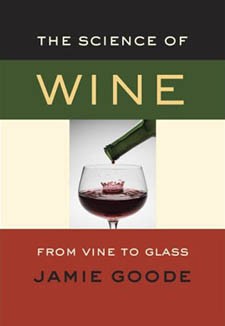
Jaime Goode is one of the best popular science writers in the English language, and fortunately for us, his subject is wine, not cosmology or tropical diseases. Trained in biology, a former scientific editor, his Wine Anorak website (and accompanying blog) is a major presence in internet wine and the original source for many of the ideas explored in this fascinating, mind-opening book.
The Science of Wine isn’t a textbook on grape growing or winemaking, though it covers a lot of that ground. Its chapters are focused on key concepts and controversies in the serious wine world: buzzwords (such as terroir), cutting-edge concepts (micro-oxygenation), and issues for consumers (wine and health). It’s a wide-ranging list of topics that should have something for everyone: deficit irrigation, climate change, Brettanomyces, alcohol reduction, screwcaps, how the brain makes sense of flavor, and a dozen others.
Goode manages to construct engaging narratives of discovery without stinting on the actual science. He makes good use of interviews with leading winemakers and researchers, and writes with both clarity and charm. Readers should be prepared for periodic lists of multi-syllabic names of chemical compounds; they are, after all, the language of science, and you won’t have to memorize them for the quiz. For anyone who wants to understand more about how grapes are really grown and wine is actually made, this is a great read.
The introduction and the first two chapters, in particular, are worth the price of the book. With so much wine writing devoted to utterly subjective opinion, the opening pages are a useful, gentle reminder about how science works—rigorous, controlled experimentation, findings open to reasoned debate, and the search for rational explanation of observed phenomena. The first chapter provides a brief overview of how grapevines function, covering territory that is likely unknown even to wine lovers who understand something about what goes on in the cellar. The second chapter tackles the elusive, Holy Grail-ish notion of terroir head on, parsing out some of the different definitions, explaining what can and cannot be verified scientifically, and cutting away a lot of the dubious conceptual underbrush that has grown up around the idea that location gives wine its character.
The chapters on the craft of winemaking are excellent, and the final section on how we interact with wine is guaranteed to stretch your mind. Three interrelated chapters examine grape flavor chemistry and how the brain deals with it—the importance of aroma, differences in sensory acuity between different people, and the struggle to give clear verbal expression to ephemeral, subjective perceptions. You will never read a wine review quite the same way, and will never take anyone’s word—including your own—as Gospel again.
You could read this book cover to cover; you can just as well dip into particular chapters as the mood strikes you, or when some wine geek drops a string of terms you aren’t familiar with. Either way, if you want to understand the science behind what’s in your glass, this is the place to go.
 Jaime Goode, The Science of Wine: From Vine to Glass, University of California Press, 2006, $23.07 (hardback).
Tim Patterson writes for several wine magazines, blogs at Blind Muscat’s Cellarbook, and co-edits the Vinography book review section.


