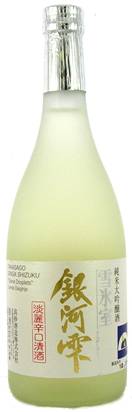
It is deep winter. The snows lay heavy on the mountains of northern Japan. Cedar trees hang sparkling, dusted with ice, over frozen rivers and streams. The air is crisp, even crystalline in its stillness, and the white landscape yields only the slightest muffled sounds.
In the heart of this winter landscape a strange sight emerges every winter. A huge igloo, constructed entirely of ice, filled with rotund canvas bags. From these somewhat alien shapes that hang suspended from the ceiling at minus 2 degrees Centigrade, drip solitary drops of a sake unlike any other in the world.
This strange midwinter landscape on Hokkaido, Japan’s northernmost island, is the result of one of the more esoteric and regimented sake brewing processes found in Japan, and is constructed each year by the Takasago brewery to make their most precious product, a sake which they have appropriately named “Divine Droplets.”
Much like winemaking, the sake making process involves fermenting a big tank of liquidy mushy stuff that gradually turns into alcohol as the fermentation process progresses. Once fermentation is complete, that liquid mash — the alcohol plus the solids that are called “lees” are generally pressed in a big mechanical device to extract the liquid and leave the solids behind.
In winemaking, however, there tends to be quite a difference between the wine that simply runs trickling out of this mush (known as “free run juice”) and the wine that is extracted through pressing. The former is usually more balanced, less tannic and bitter, and generally higher quality wine than the pressed wine, which tends to contain such flavors because they are extracted from the skins and seeds as they are compressed. There is such a marked difference between the two “juices” that many top wineries only use the free run juice, and simply discard or sell off their press juice in bulk.
The sake making process is quite similar in that at a certain point most sakes are pressed off their lees, however the press juice in sake making is the most common source of juice for even the most premium sakes. Rice, of course, lacks the skin and seeds which contribute to the difference in flavors between free run and press juice in wine, so the juice pressed off the sake is not particularly undesirable.
Having said as much, however, there are those in the sake world like Takasago Shuzo who take pains (and great expense) to produce their own version of “free run juice” through the slow, painstaking, and very low-yielding process of drip pressing their sake. The brewers who believe that letting only the action of gravity on the lees extract their sake suggest that the resulting sake is the most delicate, and my limited experience with such sakes makes me inclined to agree. Perhaps just like Pinot Noir, which is famous for its delicacy and tendency to react poorly to rough treatment in the winery, top quality rice mash produces different results if it is babied through the process.
Takasago Shuzo was founded in 1899 in the town of Asahikawa City in Hokkaido, making it one of Northern Japan’s oldest operating breweries. This area of Japan is home to many sake breweries, as it offers two things essential to brewing premium sake: cold temperatures and pure mountain spring water. Temperatures in the area regularly fall to minus twenty degrees centigrade and the mountains of the area offer a bounty of springs, some of which have been used by sake brewers for centuries.
The importance of temperature in brewing sake has to do with the minimization of contamination by airborne yeasts and bacteria. Even a small amount of foreign biological agents can significantly affect the flavors of a sake as it ferments. The still, cold winter temperatures in the unheated sake brewing buildings of most breweries tends to minimize such contamination, but if you really want to eliminate all foreign agents, one of the things you might do would be to build a giant igloo in which to make your sake.
A lot of sake, especially the most refined junmai daiginjo sakes like this one, in which more than 50% of the mass of each grain of rice have been polished away before brewing, tend to evoke winter landscapes for me. I suppose that part of this quality I project into the sake, knowing how and where it is made. But the clean, crisp qualities of some sake really do evoke the heart of winter, with aromas and flavors that are instantly familiar to those who grew up in the snowy mountains, as I did.
The way Divine Droplets is made makes it a special sake. But it’s beauty is revealed only through its tasting. This is one of the most exceptional sakes made in the world, and one of my personal gold standards for the magical qualities that daiginjo sakes can possess.
Tasting Notes:
Colorless in the glass, this sake smells of rainwater, wet cedar, and flowers, with a hint of malted milk. In the mouth it is effortlessly clean, beautifully balanced, and sexy-slippery as it moves across the palate. The delicate flavors swirl between jasmine, melon, and a quartz-like mineral quality that is hard to describe. As with some of the finest white wines, this sake is so aromatic that there is the illusion of sweetness in the flavor that is completely disarming, as any concentrated effort to actually taste sweetness is impossible — the sake is bone dry. The finish is marked by a pleasant, malted milk-ball quality that lingers for a long time and then slowly fades.
Food Pairing:
Classically delicate in nature, this sake is a beautiful accompaniment to sashimi (how about albacore or yellowtail?) or lightly seared fish in the tataki style. Its subtlety will be overwhelmed by strong flavors, so it is best paired with milder foods.
Overall Score: between 9.5 and 10
How Much?: $45 for 720ml bottle (also available in 300ml bottles).
This sake is available for purchase on the Internet.


