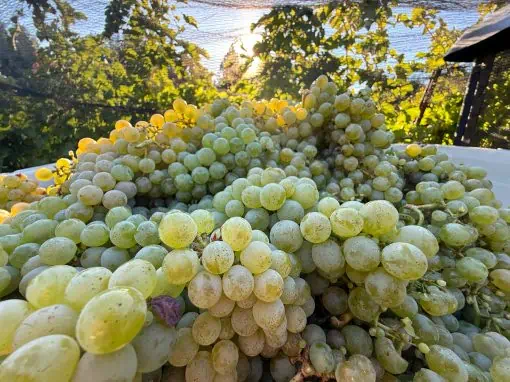
When the Rhône Ranger movement in California selected Syrah as the variety to champion above all others, they bet on the wrong grape. Syrah’s struggling sales over the last 20 years offer clear proof of that. I find myself wishing that they had chosen Grenache instead. Especially as more producers begin to bottle lower-alcohol, whole-cluster influenced, energetic versions of the variety with wonderful lift and finesse, a far cry from the high-octane, oak-driven versions of the grape that dominated many of the state’s early experiments with the variety.
As these wines continue to gather acclaim, and as rising temperatures have some producers rethinking what should grow where, California Grenache has the opportunity to follow in the footsteps of Washington State, as described last October by Patrick Comiskey in Grenache – now a headliner in Washington.
But first, it has to shake off its reputation as an ensemble actor rather than a leading player.
Perennially second fiddle
Charles LeFranc’s 1852 grafting of old Mission vines over to Grenache, with cuttings brought from France, is widely regarded as the first planting of the variety in the state. The grape quickly proved its worth to early growers, adapting beautifully to California sunshine with vigour, productivity and characteristic heat tolerance.
These valuable attributes in the early days of the California wine industry prompted extensive plantings as a workhorse grape, especially in the state’s Central Valley, where it quickly became a primary source of fruit blended into swelling volumes of red jug wine. This identity as a pleasant, fruity, utilitarian variety has proven hard to shake, and perhaps as a result, its popularity has steadily waned for decades. From a height of 20,000 acres (over 8,000 ha) and 134,000 tons crushed in 1974, only 4,345 acres (1,758 ha) remain, producing roughly 33,000 tons in 2024.
Continue reading this article on JancisRobinson.com.
This article teases my monthly column at JancisRobinson.Com, which is available only to subscribers of her website. If you’re not familiar with the site, I urge you to give it a try. It’s only $135 a year (25% off for the holidays!), and well worth the cost, especially considering you basically get free, searchable access to the Oxford Companion to Wine ($65) and maps from the World Atlas of Wine ($50) as part of the subscription costs. Click here to sign up.
Winemaker Angela Osborne holds a cluster of Grenache above, courtesy of A Tribute to Grace Wines.