I have seen the future of South African Pinotage, and it cannot come soon enough for my liking. Created in 1924 by Professor Abraham Izak Perold at Stellenbosch University, Pinotage is a cross between Pinot Noir and Cinsaut, which used to be called Hermitage in South Africa back when Perold was doing his work.
Hailed as the signature South African grape and widely planted throughout the 20th Century, Pinotage has historically been reviled as much as celebrated. A lot of people simply don’t like the way it tastes.
For all its proud heritage, the grape’s flavor profile has commonly included a paint-like, band-aid, or burnt rubber character, due to an elevated combination of esters such as isoamyl acetate, mercaptans, sulfides, and other fermentation-related compounds.
Theories as to the root cause of these aromas have included virused plant material, poor choice of vineyard sites, aggressive fermentation protocols, and even the prevalence of creosote-soaked trellis posts in the vineyard.

After many decades of work and introspection, no single “smoking gun” has been found to be the cause of these aromas, but many of these factors have been methodically tackled by the South African wine industry.
Vineyards have been replanted or regrafted with plant material free of leafroll and fanleaf viruses. Site selection has become more deliberate. Fermentations have been managed to reduce yeast stress and lower temperatures, and many of the old trellis poles have been removed. The wines improved.

In addition to this (not inconsequential) work by the industry, a new style of Pinotage emerged in the 1990s that quickly became the dominant approach to making the wine following positive feedback from consumers.
Starting with deliberately lower yields in the vineyards, grapes are picked quite ripe, substantially extracted, fermented with more oxygen and less reduction at lower temperatures, and then aged in new French oak barrels.
The resulting wines are rich and robust, with a significant oak signature that is more than capable of masking many of the aromas and flavors that have traditionally turned some people off of Pinotage.
In the early 2000s, a group of producers led by Diemersfontein pioneered an even more oak-accentuated version of this style, which eventually became known as “Coffee Pinotage.” This oak-dominated flavor profile (which can taste remarkably like coffee) won significant consumer acclaim, though some critics believed these wines lacked both varietal and geographical specificity.
For the next two decades, much of the industry settled around a single dominant aesthetic: ripe fruit, substantial extraction, generous new oak, and elevated alcohols.
Today, that style feels something like a relic of late 1990s winemaking. And it isn’t something that I, and I believe a lot of other people, really want to drink.
Dominated by mocha and espresso notes, often featuring dried rather than fresh cherry and berry flavors, sometimes with softer acidity, alcohols in the mid-to-high 14% range, and with tannins that can be quite substantial, these wines are neither exciting nor refreshing, and taste more of oak than of place.
There have always been producers capable of elevating the style. Abrie Beeslaar, first at Kanonkop and later under his own label, has consistently made some of the better examples of traditionally styled Pinotage. Yet even these wines largely operate within the same ripeness and structural paradigm, simply with more freshness and less overt mocha character.
A New Vision for Pinotage

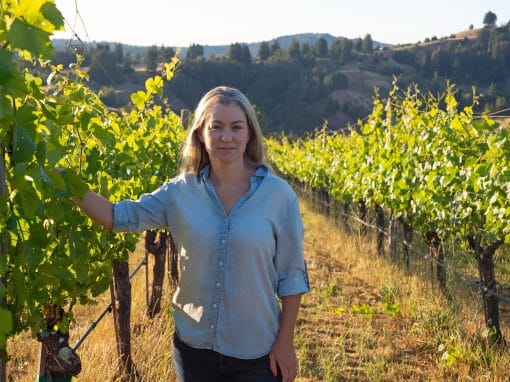
Then, in 2022, while attending the annual CapeWine fair, I had a Pinotage that blew my mind and completely upended my conception of what the grape was capable of. Electric with acidity, crunchy and stony in character, light colored, saline, and with no trace of wood signature, the 2021 Wolf and Woman Pinotage made by winemaker Jolandie Fouché (who is pictured at top) was a revelation. It was also her first vintage of making wine under her own label.
Made from vines planted in 1973 and grown on decomposed granite and clay, fermented with a portion of whole-cluster, aged in neutral oak, and clocking in at under 13% alcohol, it was like stepping into an entirely different universe, where Pinotage could be fresh, energetic, savory, and yes, delicious.
This, my friends, is definitely where Pinotage needs to go. Or rather, where it needs to be dragged, kicking and screaming.
Ironically, the day after tasting Jolandie’s Pinotage, I attended an event in Cape Town thrown by the Pinotage Association of South Africa designed to showcase and celebrate the grape and its pride of place in South Africa. I asked our hosts (venerable Pinotage winemakers, all) about the opportunity that newer, unoaked, and less-ripe styles of Pinotage might represent in the future, and the premise of my question was roundly dismissed.
Pinotage requires a certain level of ripeness and a certain level of oak aging for it to truly express itself, I was told. It can’t really make a decent wine under 14% alcohol, said the white-haired man standing at the front of the room.
And that, it seemed, was that. The old guard had spoken, and the upstarts simply needed to get on board with the right way of doing things.
Nonetheless, since then, a growing alternative to that ossified conception of Pinotage has begun to emerge, with winemakers such as Fouché treating the grape less like Cabernet Sauvignon and much more like Gamay, Mondeuse, or (heaven forbid) Cinsaut. Some of these wines feature carbonic or semi-carbonic maceration. Many feature whole clusters. Most are picked for alcohol levels much closer to 13% than 14%.
It turns out that the most exciting future for Pinotage might actually be in rediscovering the freshness, savouriness, and drinkability that were hiding inside the grape all along. Nearly a century after Perold crossed Pinot Noir with Cinsaut, a few bold South African winemakers finally seem willing to let Pinotage behave a little more like both of its parents. The rest of the industry should follow their lead.
Here are some of the South African Pinotages that are changing the game.
Tasting Notes

2025 Aslina “Ndubs” Red Blend, South Africa
Medium garnet in the glass, this wine smells of underbrush, berries, and flowers. In the mouth, fleecy mouth-coating tannins wrap around a core of cherry and plum, as notes of herbs and crunchy acidity linger in the finish. A fun wine. Carbonically macerated. This first vintage is labeled just as a red wine, as it contains 9% Shiraz. Winemaker Ntsiki Byela says she will probably label it as Pinotage in subsequent vintages. 13% alcohol. Score: between 8.5 and 9. Cost: $21. click to buy.
2023 David & Nadia “Topography” Pinotage, Swartland, Coastal Region, South Africa
Medium garnet in the glass, this wine smells of flowers, plums, berries, and earth. In the mouth, saline flavors of plum and berries, green herbs, and earth are juicy with excellent acidity and have a great length. There’s a faint green herbal bitterness that lingers in the finish. Matured for 1 year in foudre. 20% whole cluster fermentation with ambient yeasts. 12.5% alcohol. Score: between 9 and 9.5. Cost: $28. click to buy.
2017 FRAM “Kromme Valley” Pinotage, Citrusdal Mountain, Olifants River, South Africa
Medium garnet in the glass, this wine smells of bright berries and a hint of balsamic. In the mouth, wonderful boysenberry and cherry flavors are wrapped in muscular tannins and shot through with hints of dried herbs. Bright, crunchy acidity. 13.5% alcohol. Score: around 9. Cost: $30. click to buy.
2021 FRAM “Kromme Valley” Pinotage, Citrusdal Mountain, Olifants River, South Africa
Medium garnet in the glass, this wine smells of flowers, blueberries, huckleberries, and elderberries. In the mouth, plush, velvety tannins surround beautifully floral mixed berry fruit. Great acidity and a nice earthy black tea note in the finish. Very impressive. 13.5% alcohol. Score: between 9 and 9.5. Cost: $30.

2023 Illimis Pinotage, Polkadraai Hills, Stellenbosch, Coastal Region, South Africa
Medium garnet in the glass, this wine smells of ripe berries, plums, and herbs. In the mouth, the wine is crunchy and bright with plummy berry and green herb notes wrapped in fleecy tannins. Excellent acidity and lovely minerality. Yum!! A mix of carbonic, whole bunch, and destemmed fruit. Aged for 8 months in old oak. 13.5% alcohol. Score: around 9.5. Cost: $??
2023 McFarlane Wines “Saturday’s Child” Pinotage, Coastal Region, South Africa
Light to medium garnet in the glass, this wine smells of plum and berries, flowers, and herbs. In the mouth, fleecy tannins surround crunchy acidity that makes berry and plum flavors zingy as they are shot through with dried and chopped fresh herbs. Excellent acidity. 10% whole clusters used in fermentation, then aged for 11 months in old oak. 12.5% alcohol. Score: between 9 and 9.5. Cost: $30.
2022 Natte Valleij “Nat” Pinotage, Darling, Western Cape, South Africa
Light garnet in the glass, this wine smells of chopped herbs and raspberries. In the mouth, tangy sour cherry and raspberry fruit flavors are crunchy with excellent acidity and wrapped in lightly gauzy tannins. Lifted, bright and zingy-delicious. Dry-farmed bush-vines. Aged for 8 months in a concrete egg. 12.5% alcohol. Score: around 9. Cost: $17. click to buy.
2023 Scions of Sinai “Atlantikas” Pinotage, Helderberg, Stellenbosch, South Africa
Medium garnet in the glass, this wine smells of flowers, red fruit, and a hint of warm tire. In the mouth, crunchy bright acidity makes flavors of red berries, dried herbs, and flowers positively zingy. Fresh, juicy, and bright with muscular tannins. The bush vines used for this wine were planted in 1976 and 1999, and are farmed regeneratively without irrigation. Fermented with a submerged cap in stainless steel with ambient yeasts and a combination of 30% destemmed, 30% whole cluster, and 40% direct press juice. 12.5% alcohol. 1085 cases made. Score: around 9. Cost: $21. click to buy.

2024 Scions of Sinai “Atlantikas” Pinotage, Stellenbosch, Coastal Region, South Africa
Light to medium garnet in color, this wine smells of berries, herbs, and earth. In the mouth, light powdery tannins coat the mouth as flavors of berries, vanilla, herbs, bitter orange, and a hint of arugula leave a spicy note on the finish. Great acidity and nice balance. The bush vines used for this wine were planted in 1976 and 1999, and are farmed regeneratively without irrigation. Fermented with a submerged cap in stainless steel with ambient yeasts and 33% whole clusters. 13.5% alcohol. Score: between 8.5 and 9. Cost: $26. click to buy.
2024 Wolf & Woman Pinotage, Swartland, Coastal Region, South Africa
Medium garnet in the glass, with purple highlights, this wine smells of plum, flowers, green herbs, and earth. In the mouth, bright plum and crunchy acidity are wrapped in fleecy, supple tannins as plum skin, sour cherry, and citrus peel notes mix with flowers, herbs, and earth in the finish. Comes from two sites, one featuring granite soils, the other featuring clay soils. 15% whole-cluster fermentation beginning with a 4-day cold soak. Spends 3 weeks on the skins before pressing into old 500L oak barrels for aging. 13% alcohol. Score: between 9 and 9.5. Cost: $32. click to buy.
2021 Wolf and Woman Pinotage, Swartland, Coastal Region, South Africa
Medium garnet in the glass, this wine smells of chopped herbs and berries. In the mouth, stony and saline notes of bright berries and cherries are wrapped in lightly grippy tannins. Fantastic acidity. Comes from two sites, one featuring granite soils, the other featuring clay soils. 15% whole-cluster fermentation beginning with a 4-day cold soak. Spends 3 weeks on the skins before pressing into old 500L oak barrels for aging. 13% alcohol. Score: between 9 and 9.5. Cost: $32.
Photo of Jolandie Fouché courtesy of Wolf & Woman Wines.