
The purpose of any honest writing competition can only be to support and encourage the craft and industry of writing. Unfortunately, the times we live in now require three crucial words to be added to that statement. The purpose of any honest writing competition can only be to support and encourage the craft and industry of writing by human beings.
On September 11th, the most prestigious wine communication competition, the 67 Pall Mall Global Wine Communicator Awards, awarded one of its writing prizes to a piece of work that seems to have been written entirely by AI. Understandably, the wine writing “industry,” such as it is, has responded vociferously with a measure of both outrage and disbelief. I recommend reading the pieces by Henry Jeffrys, Felicity Carter, Joe Roberts, Alice Feiring, and Peter Pharos to get a sense of the response to date.
I’ve personally been waiting to see how the organizers of the competition would handle the situation. The totality of their response, provided not in any official statement but merely in quotes to some of the inquiring journalists listed above, appears to consist of the following:
- A defense of the judges and judging process while clearly pointing out that the contest rules did not explicitly forbid AI (which is true)
- A defense of the piece’s contributor, who, they imply, has maintained it was not written entirely by AI
- A professed lack of confidence in AI-detection software and a suggestion that the author’s personal style is naturally similar to the supposed telltale signs of AI writing
- A suggestion that many people criticising the award decision simply do not like the piece of writing, and that perhaps “they are not the intended audience” for the work
When approached by some of the journalists above, the contributor of the piece in question has declined to comment and referred inquiries back to the contest organizers.
Let’s return to the (hopefully uncontroversial) premise that any writing awards program in existence would aim to support, encourage, develop, promote, and celebrate quality writing by human beings. After all, the name of the specific award program in question includes the word “communicator,” suggesting some entity doing the communication that we shouldn’t be too hard-pressed to assume is a human individual.
All that being the case, it seems to me that the only policy when it comes to the use of AI in a contest such as this would be one of ZERO TOLERANCE.
You simply cannot be in the business of recognizing the efforts and craft of writers and simultaneously be willing to accept and evaluate work that was substantially, let alone entirely, created by artificial intelligence.
This is not to say that writers should not be able to utilize AI as a tool in their process.
You want AI to check your grammar? Fine. You want it to give you suggestions on how to better structure your argument to be persuasive? Great. Need an idea for a metaphor that might achieve your goals? Go ahead and get some advice from your favorite chatbot. But when it comes to the words that end up on the page in consideration for awards, prize money, and accolades, those need to be produced by a human being. Period.
The fact that an explicit AI policy was not in place, therefore, does not seem to be a reasonable excuse for tolerance of AI-generated work as a contender for the awards. That seems tantamount to accepting that Rosie Ruiz was well within her rights to hop into a taxi for the last six miles of the 1980 Boston Marathon. The race rules definitely didn’t say she couldn’t do that.
It seems to me that when faced with allegations (substantiated by multiple results from AI detection software) that a piece selected by the judges was mostly or entirely written by AI, the folks at the 67 Pall Mall Awards had only two plausible courses of action to maintain the credibility of their awards program.
Option one was to publicly and officially acknowledge the controversy; offer a mea culpa for not having had a policy forbidding AI work in place; and then proceed to run every finalist piece of work through an AI detector and revise their awards decisions based on the outcome of those tests. Of course, if those tests were inconclusive or ambiguous, no revision need be made.
Option two was to publicly and officially acknowledge the controversy; offer a mea culpa for not having had a policy forbidding AI work in place; and then state clearly that while they are declining to revise their award decisions already communicated this year, they will have a zero-tolerance policy for AI-created work moving forward.
I would certainly have advocated for the first option.
Unfortunately, the organizers have chosen to do neither of those two things, and have made it clear in response to my inquiries that they will not even be issuing an official statement on the situation to everyone who submitted work to the contest, let alone to the public at large.
This is disappointing and, in my opinion, not the way to handle what has clearly become a public relations crisis that threatens the integrity of the awards program itself and undermines the very craft the organizers purport to celebrate.
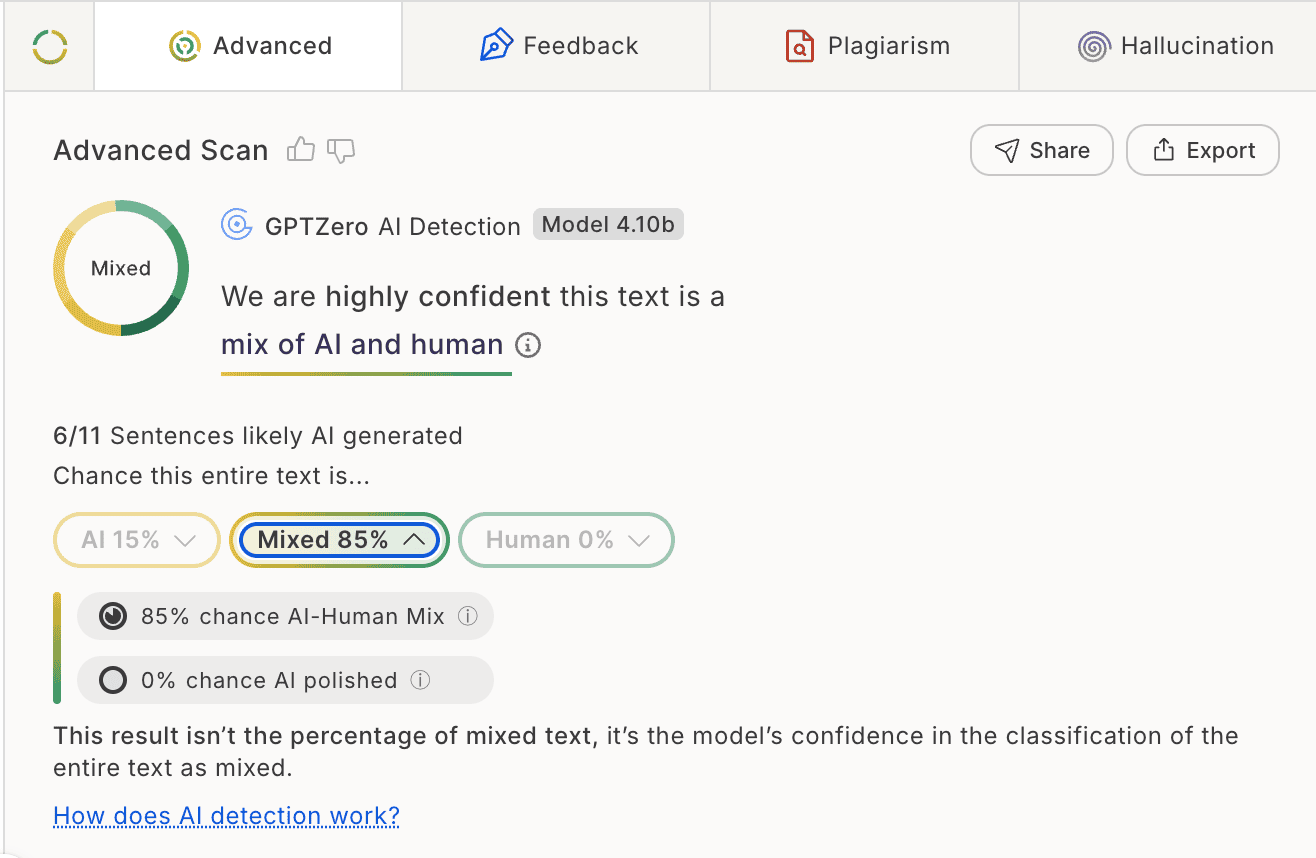
In the face of this seeming inaction, I’ve gone ahead and run the text of all six finalists for this award through GPTZero, which I believe to be the best AI-detection software in the business. The results, which you can see below (click to enlarge), are stark.

Five of the pieces come back rated as being 100% human-written. One, the chosen winner of this award, comes back as 100% AI-written. This is a detector that measures the presence and influence of AI in single-percentage increments.
The definitiveness of this result cannot be minimized or brushed away by conversations about software quality and on-trend writing styles.
Let me offer some additional, more detailed perspective. I spent my entire professional career in the technology and design world, running a full-service digital marketing agency for two decades. I have been an early adopter and student of AI. I use it daily, and in so doing, save myself tens of hours of work per week, including getting feedback and advice on my own writing from time to time. And while I use it to generate art for my site, such as the image at top, I do not use it to generate content published under my byline here or anywhere else. But I use it. A lot.
More specifically, I used AI-writing detectors extensively for more than 2 years to evaluate the personal statements submitted along with scholarship applications to the Glancy Wine Education Foundation, which has a zero-tolerance AI policy for these statements. That work has involved evaluating hundreds of pieces of writing in that time period with many different tools, eventually leading me to my chosen piece of software and a serious degree of confidence in its capabilities.
I can tell you definitively that the best of these tools are really, really good. Are they infallible? Of course not, but they have gotten very sophisticated and nuanced in their evaluation capabilities, which, as I mentioned, can be expressed at incremental percentage points of confidence. They are absolutely and readily able to distinguish between text that has been modified by AI, text that contains only some AI content, and text that was produced wholesale by AI. These tools are not thrown off by short sentences, word cadence, em-dashes, or overly snappy writing. By way of example, one of the other finalists I evaluated above was an honest-to-goodness poem, and it was scored as being 100% human-written.
In my judgment, the 67 Pall Mall Awards have a serious problem that they have chosen not to fully resolve. They have been quoted in at least one of the pieces above as saying that they are formulating an AI policy for next year, but hearing in 8 months that next year’s awards won’t allow AI (let’s pray, shall we?) will be cold consolation to the people who lost to a chatbot this year. I seriously hope none of them paid their own hard-earned money for a plane ticket to attend the awards ceremony in London as a finalist.
What’s more, I can’t shake the feeling that this isn’t just a story about a wine-writing contest fallen victim to the pitfalls of an AI-enabled world. It’s a symptom of a profession slowly being strangled.
I have not been one of those people crying that AI is coming for all our jobs. I’m very optimistic by nature, and that optimism extends to the possibilities that AI, properly utilized and controlled, offers for humanity.
But let’s face it, wine writing as a profession has been dying a long, drawn-out death. This situation, in which the arguably most prominent arbiter of quality in the craft of wine writing is awarding £3000 in cash to a piece of writing clearly written by AI, feels like yet one more nail in the coffin of a profession not long for this world.
It has always been extremely difficult to make a living as a wine writer. That was true when I started writing about wine 22 years ago. It has only gotten worse. Much worse.
In the span of time I’ve been writing about wine, the world of print journalism has been decimated. According to a report commissioned by the Library of Congress, newspaper ad revenue dropped roughly 80% from a peak of $73.2 billion in 2000 to just $6 billion in 2023. In roughly the same period, 3,500 newspapers ceased publication. Print magazine advertising spend dropped roughly 70% in the same period, according to Statista.com.
Thank you, Google Ads.
I can still remember a time when the newspapers in most major metropolitan areas had wine columns. No longer.
Salaried wine writers represent a nearly extinct species. Even at the most storied publications, including my employer Jancisrobinson.com and Decanter, most content is generated by freelancers who get piece rates and receive zero benefits.
When 60 to 80 hours of work driving around wine country to taste and conduct interviews nets a freelance wine writer $300 for 1300 words, and no expense reimbursement (real rates, real facts, people), is it any wonder that fewer and fewer educated, knowledgeable people can even contemplate doing that kind of work?
Congratulations on spending the time and money for a four-year college degree in journalism. Now go get a job waiting tables. Here’s what one of our greatest living wine writers makes per year.
No, these days, wine writing is increasingly left to dilettantes with other income sources, many of whom have different standards for quality and no allegiance to (or sometimes even knowledge of) journalistic ethics. They’re content to get a press trip here and there, and to make a couple of hundred dollars per month from their Substack subscriptions (by the way, Substack sucks).
Is it any wonder, then, that we’ve seen the sharp rise of the influencer set, who, provided they amass enough followers, can get paid $3000 for a “collab” with a brand that involves visiting a winery and popping a cork on camera while extolling the virtues of that particular slice of wine country? It’s a great gig if you can get it, but that’s advocacy-based marketing, not journalism.
Wine criticism, too, seems to be fading from relevance. Who really wants to read hundreds of tasting notes anymore? Not the young, up-and-coming wine lovers of tomorrow. They’re getting recommendations from their friends, from TikTok, and of course, from AI, which is helpfully trained on the work of all those underpaid wine writers. I don’t have any data about the subscriber bases of the specialty wine publications that trade in ratings and reviews, but I’d put some serious money on them being flat or declining, even as more and more outlets spring up to slowly fracture the audience for scores into more and more selective niches. We’ve come a long way from the days of the ParkTator.
The production side of the wine industry, which so desperately depends on wine writing and criticism, isn’t helping a bit. The roughly 11,000 wineries in the US (and countless more abroad) all want their wines scored by various publications, but most of those wineries don’t even bother to subscribe to the very publications from which they are hoping to receive coverage.
Every month, without fail, wineries whose wines I have reviewed for Jancis Robinson shamelessly ask me if I can give them a PDF of the paywalled article and wine scores, which they presumably plan on republishing with glee on their own websites and social media accounts. The degree to which the wine industry wants its cake without being willing to pay for the plate on which it is served demonstrates a staggering level of blindness and entitlement.
There is almost no one left to pay anything resembling a living wage for those who want to write about wine professionally. Fewer and fewer people therefore will write about wine, and the quality of the writing that does get done will necessarily suffer.
We are on this very downhill slide without a doubt. Where we are on the slope, and its precise angle of incline, remain fodder for much debate.
Can the problem be fixed? Sure. Just like the declining quality of our education system in the US can be fixed as soon as we start funding it well enough so that teachers can afford to live in the communities where they teach, and they don’t have to ask parents to donate pencils to their classrooms so kids can have something to write with.
Unfortunately, in neither case am I holding my breath. But the 67 Pall Mall Awards needn’t wait for the wine industry to wake up and smell the coffee. They could start by declaring that the next £3000 they hand out will, guaranteed, be celebrating real human creativity. That much, at least, is entirely within their control.
By way of disclosure, I was a finalist for one of the 67 Pall Mall awards this year (Long-form Writing) and was also short-listed, but not a finalist, in the Short-Form category, which is the subject of this article. I have also been shortlisted for these awards in previous years.