When one of the world’s most talented and ambitious winemakers decides to lay out what sounds like a grand unified field theory for making great wine, you shut your mouth and listen. Last autumn, I had the good fortune to spend an afternoon with Eben Sadie at his estate in the Swartland region of South Africa. We were joined by a small group of buyers from Madagascar, who were meeting Sadie for the first time.
Perhaps because these were new acquaintances, and perhaps because of these visitors’ unfamiliarity with his wines and with the region, Sadie offered them an unusually in-depth introduction.
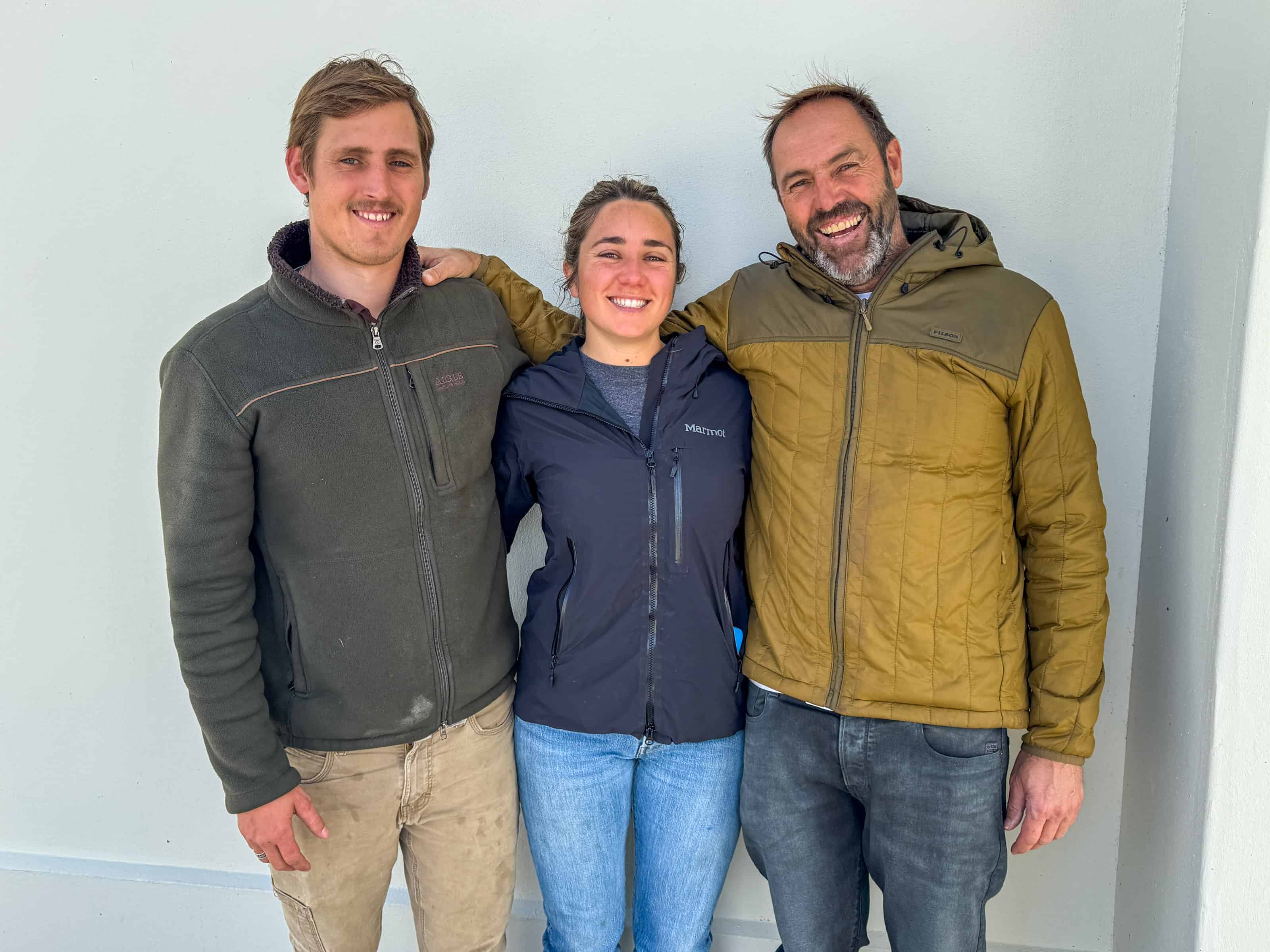
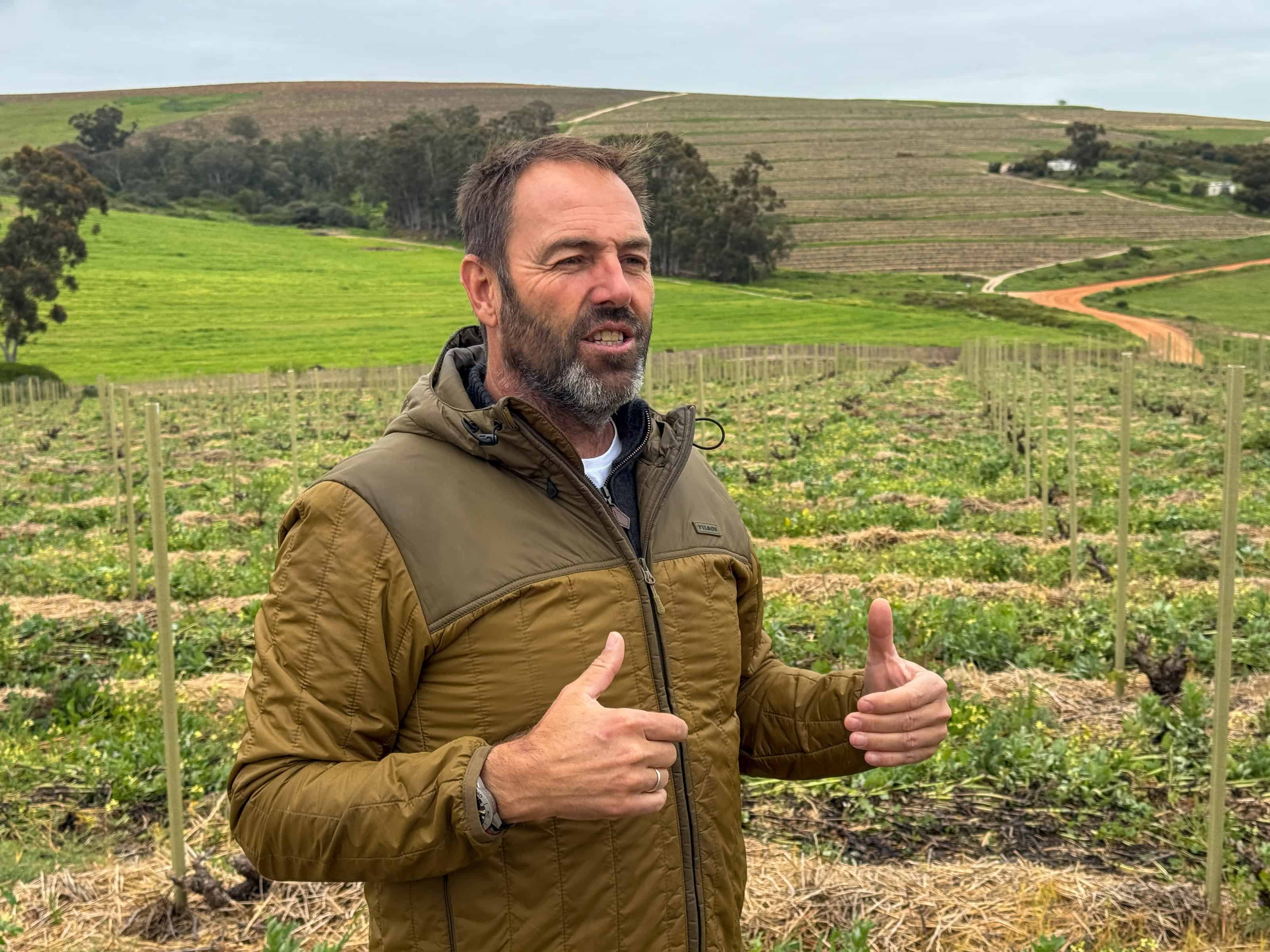
Sitting in the lounge of his new winery, along with his elder son Markus, he launched into a narrative that was by far the most comprehensive articulation of his personal history and winemaking philosophy that I’ve ever heard. I managed to record it, and have decided to offer the transcript of it here in its entirety, only lightly edited for readability.
What he had to say seemed to hang together as a single, relatively linear narrative, and it felt to me as though it was worthy of an extended read. I hope you will feel the same way.
In a recent interview with Jancis Robinson, Sadie announced that 2027 will be his last as the winemaker for his family estate, The Sadie Family Wines. He is handing the reins to his son Markus and his daughter-in-law Jessica. Sadie says he plans to continue his research and work in the vineyards, but will leave the work in the cellar to the kids.
Those who want to just skip to my thoughts on the spectacular wines of Sadie’s most recent vintage can jump to the reviews here.
Otherwise, here’s Eben Sadie explaining, well, everything.
I did not grow up in a family of wine. I grew up on the coast here in the Swartland, completely disconnected from wine and food. We ate food because we wanted to stay alive, but we didn’t know that food could be something else. I grew up in a pretty small village. Nobody was rich, nobody was really very poor. It was just balanced—everybody living in each other’s houses—that kind of life.
I grew up loving the ocean a lot. I mean, you love living in a beautiful place where the ocean is very much a part of your life. I was always windsurfing, kitesurfing, surfing, diving. There was a point in my life when I thought I would study Marine Biology.
So for me, ultimately, it was between Marine Biology and Agriculture. In 1990, at that time, you still had to go to the military in South Africa; it was compulsory. So I went to the military in 1990. And by the time I had almost finished with the military, I decided I would study agriculture.
I went to go study in Stellenbosch. And when you study agriculture in Stellenbosch, you are almost never disconnected from wine. Stellenbosch is such a genius town, you know. In Stellenbosch, everything is wine. And from living there and studying there, my contact with wine grew more and more.
As a young student, I joined a tasting group, and I started tasting the great wines. There was a very important restaurant there at the time, run by Mark Kent, that today is Boekenhoutskloof. Mark introduced me to a lot of the great wines of the world at that early stage. I was 20 years old when I tasted Latour, Mouton, Haut-Brion, Cheval Blanc, Ausone—all those wines. And for me, it changed my world.
Studying, we didn’t always have the money to taste wines, but we found ways. I chose to work in restaurants. It was one way to finance my drinking. My life was work in restaurants, get money, buy wine, drink wine. So by the time I was going into my third year at Stellenbosch, I decided to study oenology. But I came into wine through drinking, not studying.
I was drinking wine and saying to myself, I want to do this.
It’s important to know that when I qualified [from university] it was 1994. That’s a very important date, because it’s also the year of the birth of the new South Africa. I was finalizing my studies at the same time the new South Africa was being born. So when I started my career, I started my career in the New South Africa, not the Old South Africa. It’s an important point because in a way, I’m the oldest qualified ‘young’ winemaker in the New South Africa.
Had I qualified two years before, I would not have had the same entry into the world. When I finished studying, I could all of a sudden go anywhere in the world. Before that, we were embargoed. We couldn’t travel. And that is very important.
Many of the winemakers who are my senior, all our senior winemakers—my mentors—they couldn’t travel. And that’s a big difference. I believe that in life, if you want to become the best, you have to work with the best.
If I want to compete in the Tour de France, if I want to ride with those guys, I cannot just ride my bicycle around here. I have to go ride with them. If I want to run like Usain Bolt, I have to pack my bags, I have to go to Jamaica, and I have to start running with him every day. When he wakes up, I wake up. If he puts on his shoes, I put on my shoes. I start running when he starts running, and I stop running only when he stops running. Or I run more. There’s no way to become the top in the world if you don’t play with the top. There’s no other way. You need the time. You need the contact. You need to learn about determination, tenacity, ambition, drive, all those things.
You cannot learn those just looking at your neighbor here. Nothing will happen. You will go nowhere.
So I left South Africa for a long time. Because by 1994, vignerons in South Africa had stopped dreaming. They stopped being creative. They stopped having ambition because of the embargo. So they had no horizon. They were just here on the ground, looking at their own shoes. They were not looking out in the world. And I wanted to look like that.
So I left South Africa for some time to go work with the best guys in the world. I went to Germany first, and then Austria because of the language—it was easier to pick up. Then I went to Northern Italy and Alto Adige, also easy for the same reason. Then after that I went to France, then California, Oregon, and ended up in Spain.
In France, I was first in the Côtes Catalanes, and then I went to stay for a harvest in Beaune with a friend of mine who was at a small domaine that doesn’t exist anymore. I’ve now been to Burgundy 30 times in my life, and have been drinking the wines of Burgundy since 1994. I spent a lot of time on Burgundy, all the little vineyards, all the little things, but also on Piedmont. It’s the other place I love.
Piedmont is Burgundy with more tannins and slightly more volatile acidity. I love Piedmont, but I also love all the wines of the world, the Mosel, the Pfalz, the Loire. But you have to learn to understand these wines.
I went also to Spain. I stayed almost 10 years in Spain.
And then I came back, and I worked for several years for two companies in South Africa. But I don’t work well in a commercial environment because every time I worked for someone, they said to me, “Eben, we want to make the best wine in the world. That’s what we’re going to do.”
And I’m like, “Okay, you want to make the best wine in the world? Let’s make the best wine in the world.”
But then they would start to cut corners. They want to make money. They’d look in the Excel spreadsheet, at the bottom right-hand corner. That’s where they are looking. They are not looking at the wine. They are looking at the numbers. You say to me, you want to make the best wine, but you’re looking at the numbers.
And if you’re looking at the numbers, then you’re not going to make the best wine. The best wine you make by looking at the vineyard, by looking at the wine, not looking at the numbers. The numbers come later, much later.
But first you must make the great wine. So I stopped working for other people in 2000, and I founded this little domain.
For the first six years, I rented vineyards. And here on my property there was nothing but 10,000 eucalyptus trees. It was worth nothing.
But every year I started to pull out trees. Myself and two guys. Cut, burn, cut, burn, cut, burn. I was working in restaurants, I was working in wineries, I was doing consulting, I was even trading scrap metal just to get money. When I finally got some money, I got a machine to take out the tree stumps and burn them. Take out the roots and burn them. So this place burned for 10 years.
First you burn the top, then you burn the stumps, and then when all that is gone you have big rippers, and you rip out all the roots, which have the same quantity of material as the shoots and leaves and everything.
So this place burned three times as we took over.
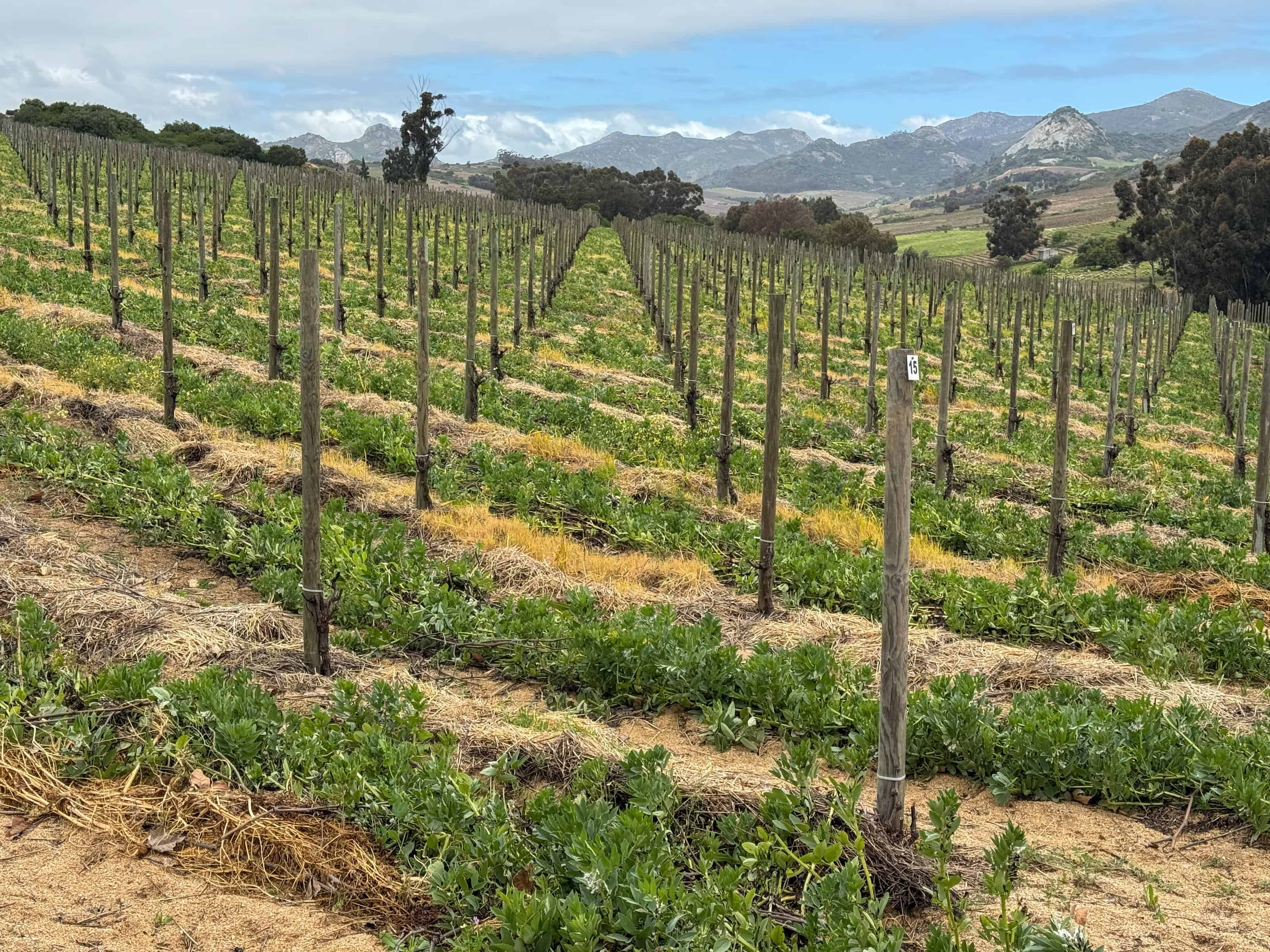
I did that for 10 years, and then I started to plant different types of cereals and legumes to revitalize the soils. That, and a lot of compost, and a lot of work, and I only planted the first vineyards in 2015, after 10 years.
In the meantime, I had other parcels that I worked that I didn’t own. I worked with other small monopoles everywhere at the same time I was developing this property, but my own vineyards only started in 2015.
With other people’s vineyards, I always did all the work. Because if I don’t grow the grapes, I don’t make the wine. For me, if you don’t work the soil, if you don’t work in the vineyard, then you don’t have the connectivity you need to make a better wine. I came out here because learning is my passion. I’m 53 this year. I’m still studying. I will never stop. It’s not passive studying, it’s active.
One of my passions is geology. On Monday last week, we just launched a map of the Swartland that I worked on for four years now. The first geological map of the appellation.
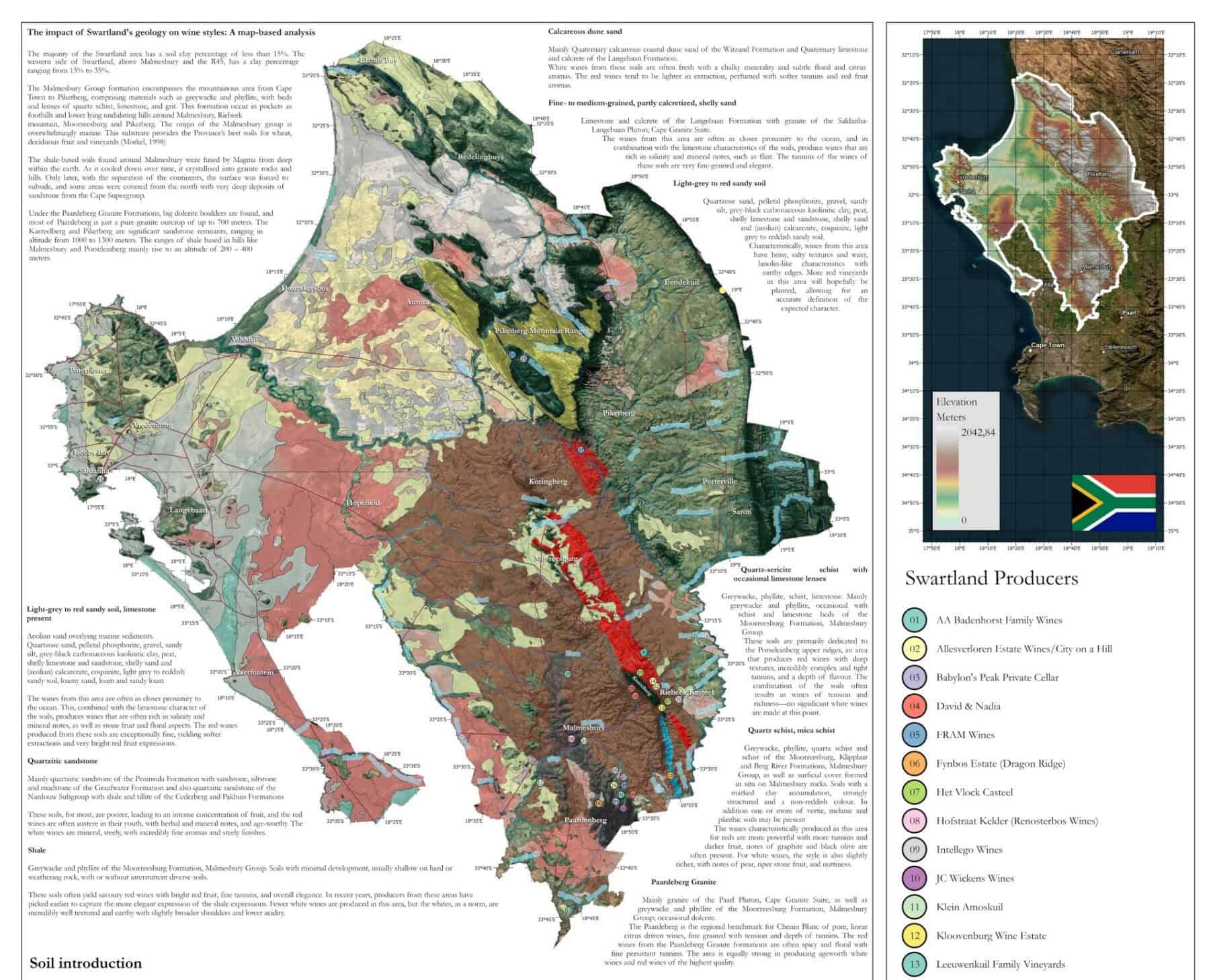
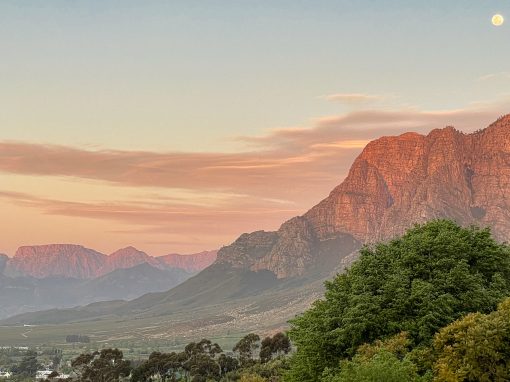
The reason the Swartland is so great is that it has the best geology in South Africa for wine. This mountain is all granite. It’s called the granite pluton, and granite is very good for red wine and white wine. You’ll find granite in the Roussillon and in the Dão in Portugal. You’ll find it in the Gredos mountains around Madrid, in Navarra. In Hermitage. Many of the great wines in the world are made from granite.
But all the sides, the hills around the sides, are all schist. Schist is very good for wine. You have it in the Douro, in Priorat, the Mosel, Ribeira Sacra, parts of the Wachau.
And then if you go over the mountain, you’ve got a big alluvial plain. Alluvial soils are not soils that were born there. They move with water. It’s a sedimentary soil. So we have a big alluvial plain going to Darling. We also have parts with deep clay, with iron and high in silica, similar to Bulgari in Tuscany, and then up north we have 100% limestone calcaire, like you find in Chablis and Burgundy and Jerez.
Then right in the middle of the Swartland we have the foot of a big mountain that is a big sandstone formation high in silica quartz.
So when you study geology globally, there is no appellation in the world that has all this in one appellation. Swartland is 990,000 hectares, and it’s got 15,400 hectares of vineyards, but the vineyards are all planted in these little microclimates that are perfect, and that’s why this place is so great, and it’s why I came here, because my study of geology helps me know exactly what soil can make what.
I work with a huge technical team – eight guys, the top eight guys in the world, and we fly satellites, and build three-dimensional solar radiation models, topography scales, GIS for airflow patterns, we scan the soil using electric resistivity tomography, and we map the soils and classify them.
So when we find a vineyard, we study it, and when we have a place where we want to plant, we also study it, and we plant it perfectly based on what we learn from the study. But sometimes there are already great things out there, and we find them too.
That’s been my last 25 years. I spent a lot of energy to find the best vineyards in South Africa. Because with winemaking, you don’t make the best wine. You make the best wine with the best vineyard. And it’s been a huge process in the last 25 years to make sure we have the best vineyards.
But then you need to know how to farm. Vititiculture is the biggest activity of our operation. We take 20% of our revenue every year and put it into research.
Every year, 20%. It’s a big number. We run on about a 31% margin, so we keep about 11%, and we put 20% back into R&D. Now we have the vineyards, and we’re only starting to make really good wine with these vineyards. I can feel it coming—the energy is coming, it’s good now but in 20 years it will be unbelievable. I’m there in the stadium, putting on my shoes, getting on the blocks, not even running yet. Just getting the things ready so that we can go.
I’ve been to most of the great and famous winegrowing regions in the world, and it’s never this diverse. If you cannot make a good wine in the Swartland, you must do something else. It’s finished for you. It’s such an amazing place.
I have friends in France making very good wine, but the places are difficult. To make good wine every year in Chinon or Vouvray, it’s difficult. The rain, the hail, the frost, the mildew. It’s tough in France. The French make the most perfect wines on the planet, and the Italians make the most emotional wines on the planet. And I hope one day we can make a wine that’s very emotional and really very well made. Perfect, I don’t know. I’m not so obsessed with perfection.
I’m more interested in making the wine of the place. But Alder, it comes back to this place, this space. Before we walk in the vineyards, I want to say, I studied biodynamics with Pierre Masson south of Burgundy, and I studied organics, and in 2001 I joined a big study group in America on regenerative viticulture. We were already talking about it then. Now it is a fashionable word.
In that study group, I sat on the panel of climate change. It’s a big topic. Even in 2001, we were starting to realize how dramatic the change of climate will be globally. So we’ve been working with GIS—I have Jaco Engelbrecht, one of the best GIS specialists on viticulture, working here a day and a half every two weeks—and with the geologists to make a strategy for the future and for climate change.
[Sadie gestures at the book Wine Grapes by José Vouillamoz, Jancis Robinson, and Julia Harding]
This has 1400 different grapes. But in the area between Crete and Lisbon we have 5000 grape varieties. Five thousand. So when you think you have 5000 grapes in such a small geographical area (that part of Europe fits into Texas and Nevada), yet we planted New Zealand, Australia, South Africa, South America, North America, and China with basically seven grapes.
Do you see the dilemma? The dilemma is that you cannot make the geometrics, the geophysics, the geology, the topography, and the climatology of six continents work with just seven grapes. It’s impossible.
You cannot argue against data. It doesn’t matter how clever you are. You cannot argue against data and statistics. You are out.
So I started in 2002 to import the best plants I could find for this place. And what is the best plant?
In the vine kingdom, you have two types of plants: isohydric and anisohydric. With an anisohydric vine, when it’s getting very warm and dry, the plants start to evaporate a lot of water. And the roots cannot take up water at the same rate as the evaporation. So the plant goes into negative hydric pressure.
The isohydric vine [in the same situation] shuts down the stomata on the bottom of the leaf. The stomata are the respiratory organs of the vines. The vine shuts down the process of evapotranspiration, and it puts on standby photosynthesis and energy accumulation between, say 11:00 AM and 2:30 PM in the day. Three and a half hours on standby.
Anisohydric is the exact opposite. They evapotranspire too much; the roots cannot take up the same amount of water, and they dehydrate.
So our focus is on isohydric plants, and the selection of isohydric plants in the Old World, which is what we started to do in 2002. To figure out whether a vine is isohydric, you have to test it with a leaf [pressure] bomb test. We have an apparatus for this. And you must test it over the whole season.
So we went to get the best isohydric grapes in the world. Assyrtiko, Agiorgitiko, Grillo, Catarratto, Fiano, Clairette Blanche, Grenache Blanc, Cinsault Blanc, Picpoul de Pinet, Grenache, Carignan, Cinsault Noir, Cunoise, Terret Noire, Vermentino. These are all very good isohydrics. And we planted a lot of them, at first in experimental patches, and it took us from 2002 to 2019, seventeen years, to do the research.
And then in 2018 we planted the first commercial vineyards with these varieties.
The other aspect we have in vines is epigenetics. The grapevine is one of the plants in the world that can mutate the fastest. It can make mutations for itself without altering the DNA of the plant, and the word for this is epigenetics.
You probably know that Chenin Blanc has been in South Africa for 300 years. Did you know that in the Loire Valley, Chenin Blanc is an anisohydric vine? But here in South Africa, Chenin Blanc is isohydric.
Here’s another example. Trousseau in the Jura in France is anisohydric. But it made its way to Portugal, where it is called Bastardo, and in Portugal, it is isohydric. It’s adapted to the drought. The Trousseau in California is also isohydric because it came from Portugal about a hundred years ago.
Isohydric plants help us keep the alcohol levels down. We stay under 14%. We have good pH. We have good acidity. We have freshness, linearity, transparency. We have precision in our wines. Because if you pick grapes at 15% alcohol. You lose the definition.
I have a friend who works in Dijon, in a lab where a lot of the wines go to be analyzed. She cannot tell me many things because it’s private, but she can share the broad statistics, and alcohol levels are 2% higher than they were 15 years ago. I don’t mind paying 500 Euros for a great bottle of Burgundy, but I’m not going to pay that for a wine at 15% alcohol. I’m not going to pay for a 16% alcohol Barolo either.
Needless to say, we’ve been doing a lot of massale selection on grape varieties that have been in areas for a long time with the right characteristics, because of this aspect of adaptation to a place.
And after you make a massale selection, what is the most important thing? To make sure that the material is virus-free. So we have a laboratory (it’s not our laboratory; we contract with them) to do tissue culture. We do in vitro tissue culture. When a plant grows, the tip of the plant, the upper epidermis, is new, and it takes 24 hours for any virus in the plant to infect new cells.
So we cut microscopically there, cut out the cells, and put them in an agar medium and let them grow, and then you cut again, and reculture, and that way you can eventually get rid of the virus. It takes a long time, and it’s expensive, but when we do a good massale selection, we want to make sure the material is clean.
America, where you live, Alder, is frankly a shit show. You Americans all go from California to Burgundy, and you brag that you cut your Pinot Noir from Romanée-Conti or Rousseau or whatever. You go and cut it and put it in the bag and take it back, but what do you take back? Virus. You people don’t know what you’re doing. You’re fucked.
That’s why you have red blotch, Flavescence dorée, Pierce’s Disease, esca. You have everything. its just bullshit. That’s not how you make a great vineyard.
We spent a lot of energy in research to make the foundation of this domain. I’m only interested in foundation. We took every Euro we had for 25 years and put it in the vineyards.
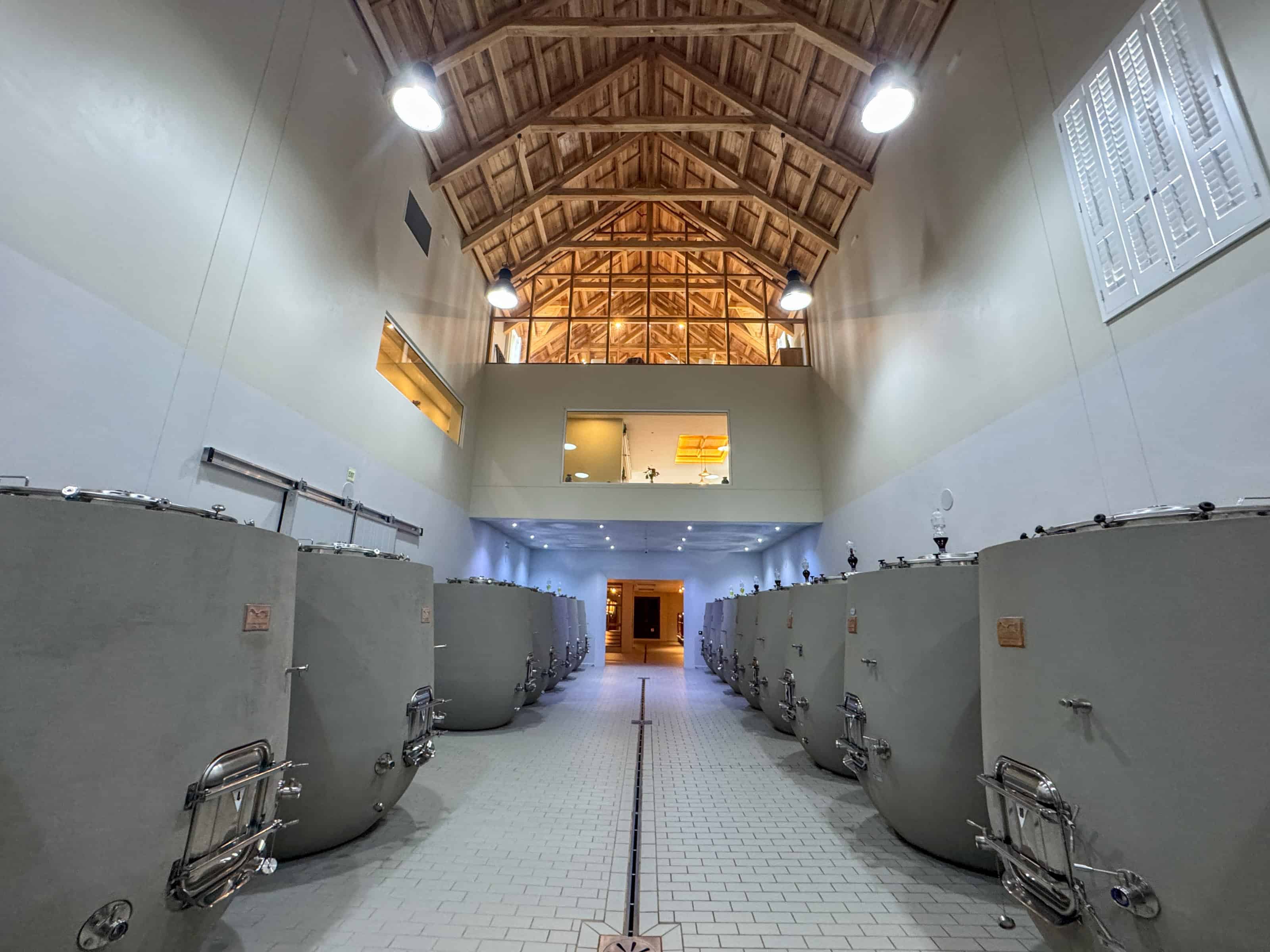
We’ve only had this new winery for 2 years. Before then, we were making wine in a shed.
This cellar was a big project three years ago, but this doesn’t change the wine. Zero. It’s a nice place to come and sit and have tea or whatever, but the cellar doesn’t change the wine.
Today we have on the domain 22 hectares of vineyards, and we have another 29 hectares that we lease. So, in total, around 51 hectares. But we don’t use all the fruit. We also sell some fruit to leading producers. We only use about 80%.
We are still working everything on gobelet. The big reason is, you know, they say the modern era of wine is the last 8000 years. It started in Georgia, Armenia, and Iran, right? And the vines came from there to Europe. So there’s been a lot of movement in 8000 years, and for the last 8000 years, this [head-trained or bush vine pruning] is how all vines were grown before.
The wires on the poles? Those are new. Only for about 120 years have we had wires on the pole—this vertical shoot positioning.
So why don’t we do it? Vertical shoot positioning was designed to mechanize vineyards, to improve the ease of working, manage yield control, all aimed at uniformity and efficiency of work, and to improve ripening.
The problem with VSP is that the canopy is very narrow, and you have a lot more evapotranspiration because you have a lot more leaves. You increase your leaf surface area, and you increase your water loss. So what happens when you put vines on VSP? You’ve created this artificial system that now has increased evapotranspiration, and so what do you have to do? You have to irrigate. You have to put in another artificial intervention. And irrigation requires energy to pump water, energy we don’t have here in South Africa.
So from a sustainability perspective, irrigation in agriculture in the long term, excessive irrigation, is not a sustainable answer. And with wine, the idea is to bottle a particular milesime, but when you irrigate, you start to lose [the characteristics of] the milesime. Your wines become monolithic.
Also, when you irrigate, you bring all the roots to the surface. The roots don’t go deep; they stay here where the water is. It’s like trust funds for kids. They usually don’t work out. Because life is too easy. Where is the character going to come from?
For us, irrigation is a no-go.
Also, we plant our vineyards square [equidistant between all plants]. With a trellis, you have high density here [in the row itself] and low density in between [in the gaps between the rows]. And you get what we call partial root zone development.
The roots are always where all your compaction is. So we have a system instead where we plant our vineyard square, where you have a 360-degree dynamic of root zone development. And then with gobelet, you have a 360-degree canopy too.
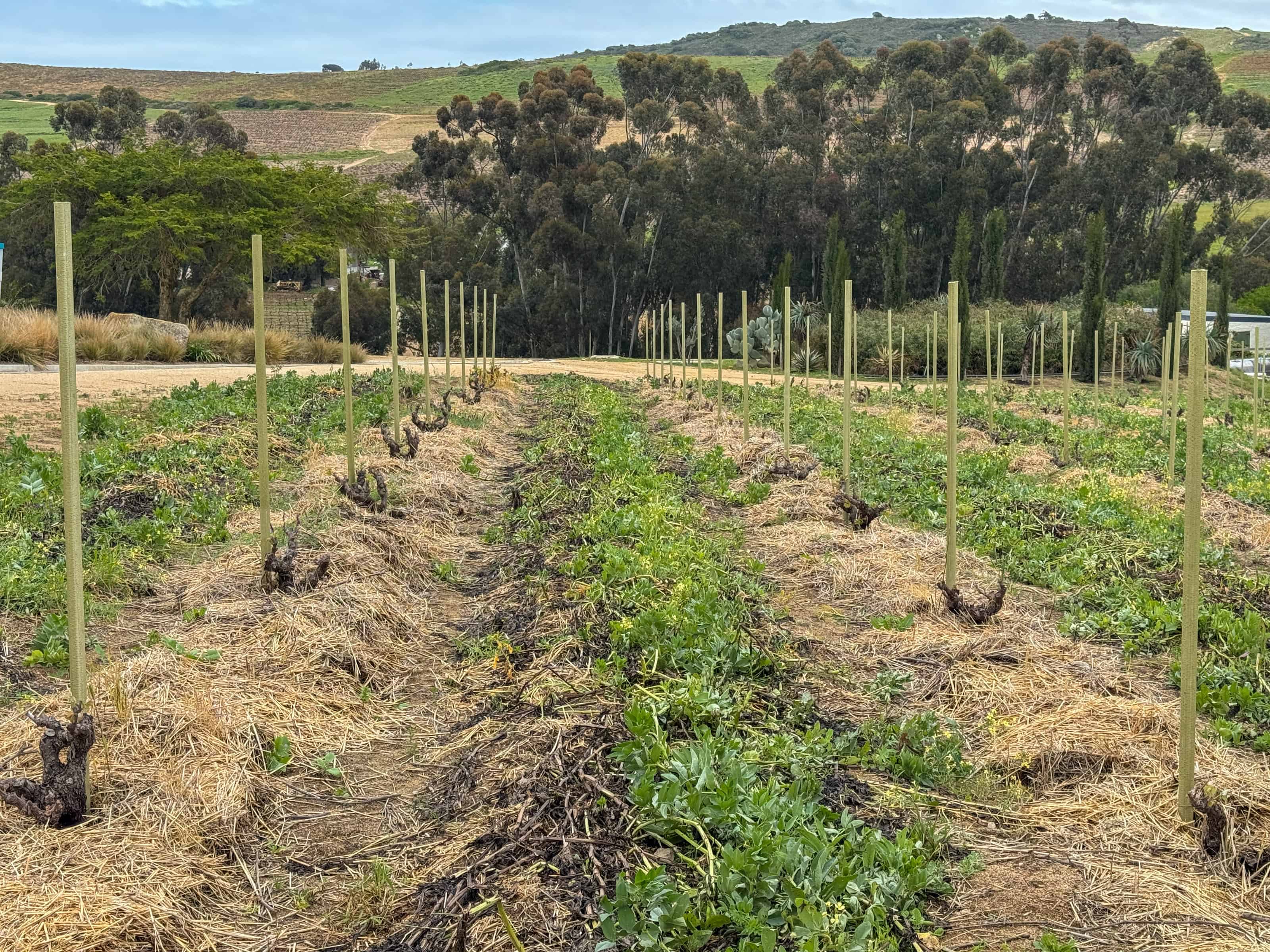
It’s like trees in nature. They are always like the number eight. What you have on the bottom, you have on the top [the same amount of plant mass above and below the ground]. When you plant VSP, you have something more like a 9. With a big canopy and vines that send their roots all into the space between the rows. Vines will never grow towards each other; they are too competitive.
So we have 360 degrees of growth, where the vines are each in their own circle. And then you can run a tractor in any direction, so you can change where it goes and you don’t get the same compaction year after year.
We use a lot of mulching for the climate [to retain moisture]. We plant a lot of cover crops. This year was fava beans to help with nitrogen and phosphates, and when it grows up, we roll it flat.
When you have a lot of grass on the ground, you keep the solar radiation off the ground, and you limit the evapotranspiration. You keep your moisture. Also, your temperature is more homogeneous. The third thing is weed control. You create shade, and the weeds can’t grow in the shade. You do your weed control with shade. And lastly, the cover crop is all carbon that will go back into the soil to build better soil for next year. Because if you can increase your carbon percentage in your soil, you increase your water-holding capacity, your mineral capacity.
We plant blends. We don’t make blends in the cellar or on the table, we make them in the vineyard. If you blend in the cellar on the table, you are starting to work with your brain. You’re starting to think about the Wine Advocate, or what Alder is going to write in his report. About consumer expectation, about ego.
No, I’m here growing wine. We are wine growers, not wine makers.
When we have 20 years of wines to taste through, a vertical, I don’t want 300 different notes saying, “This year I did this to the wine, this year I did that.”
I want to simply say, “This vineyard, what did this vineyard do for each of these 20 years?” This vineyard—not me, not my technicians—this vineyard.
We farm organically, but I will never put it anywhere on the bottle. As for biodynamics, I like biodynamie, I just don’t like biodynamists. They are so fucking dogmatic. Dogma kills the brain. Rudolph Steiner was not the last clever guy on the planet. We cannot stop our thinking as of 1925 [the year Steiner died]. So much has been learned by so many people in the past 20 years alone.
If I put 500 and 501 on the vineyard, then I’m a cool kid. I can get 20 extra Euros a bottle. Fuck that. It’s like silver bullets and recipes. No, you have to use your brain. You must keep developing your viticulture. You must keep developing your plant material. You must keep developing your team, the team that does the work. That’s the business. Not the business of doing paperwork, of having all the consultants come in and file their forms. Fuck that. It will never work for me. I’m not making wine for them. I make wine to make the best wine I can, and I will use whatever resource I can get my hands on.
It would be good for the organic movement for me to be certified. But the organic movement is not my movement. My movement is wine.
For winemaking, the white grapes come in, and they get chilled for the night to six degrees [Celsius]. The red grapes come in and go into the destemmer.
We make every white wine the same, and every red wine the same. Always, because when we taste the wines, we don’t want to taste the winemaking, we want to see the vineyards. When you do research, or any clinical trial, the most important thing is your control from which you will make every measurement. And if you have too much variability, you will never know what you do.
So winemaking here is very easy. The whites are pressed with whole clusters in the pneumatic press, and everything [including all the lees] goes into the tank. The reds always have 30% whole cluster no matter what. Never higher, never lower, and they are all basket-pressed, and we use all of the press juice, no fractions, no press cuts.
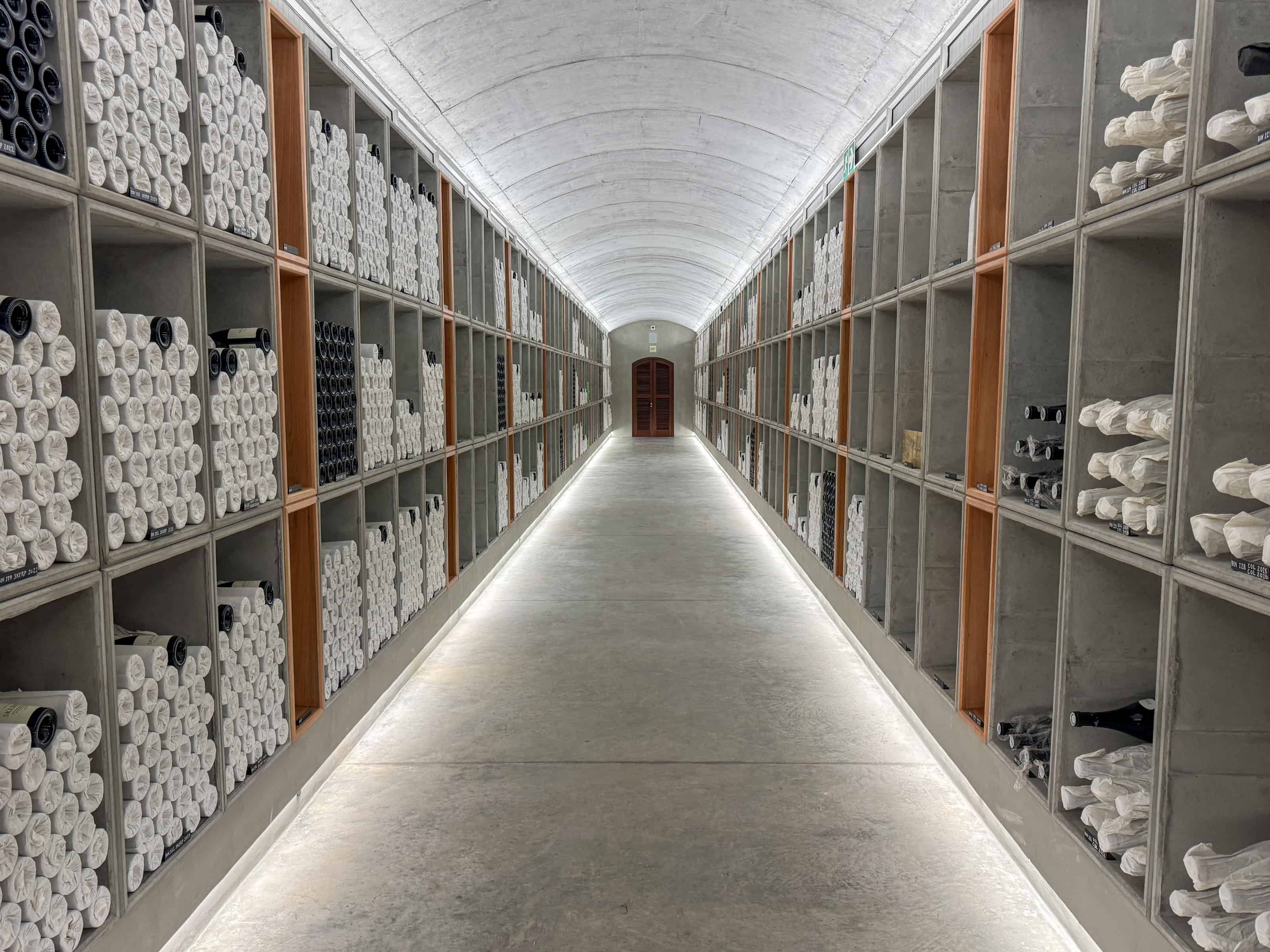
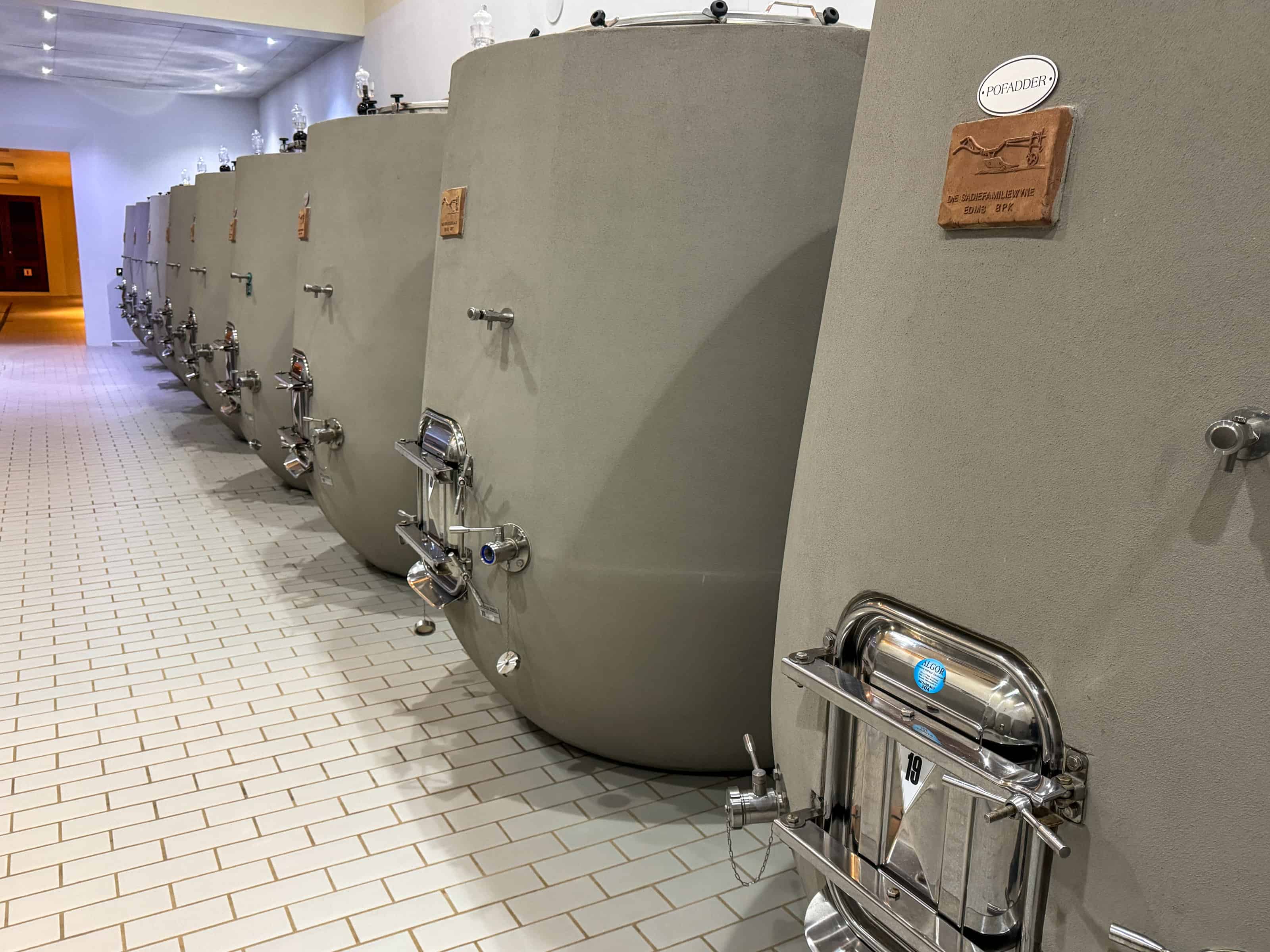
The whites and reds ferment in concrete. Each individual vineyard gets its own permanent tank where it ferments each year. Each tank has its own microflora, but just as importantly, once we’ve figured out a system, we don’t have to figure it out again. The wines are aged in a combination of amphorae, concrete, and large oak foudres, or occasionally, only in foudre.
The winery is designed with energy efficiency and water efficiency. We use all the water that falls on the roofs. And then the water we use in the cellar we put back into our gardens, and into our water purification plant, which makes water perfect for the house, the cellar, the people.
Up top we have a huge solar plant with 2 megawatts generation. We use one of those megawatts, and the other goes into a battery bank for storage. Since 2022, we are completely off the grid.
And with that, it was time to taste.
Tasting Notes
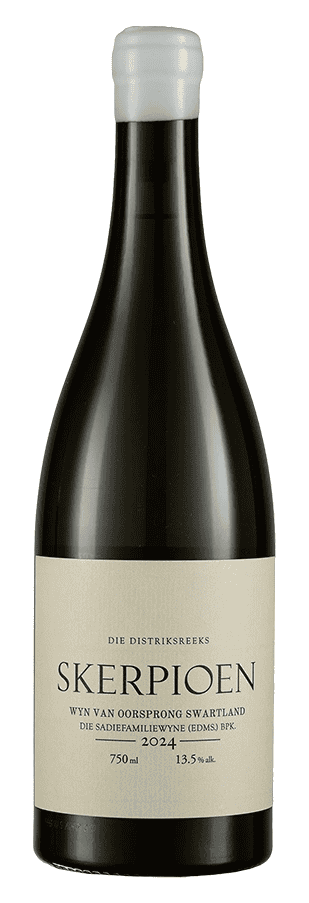
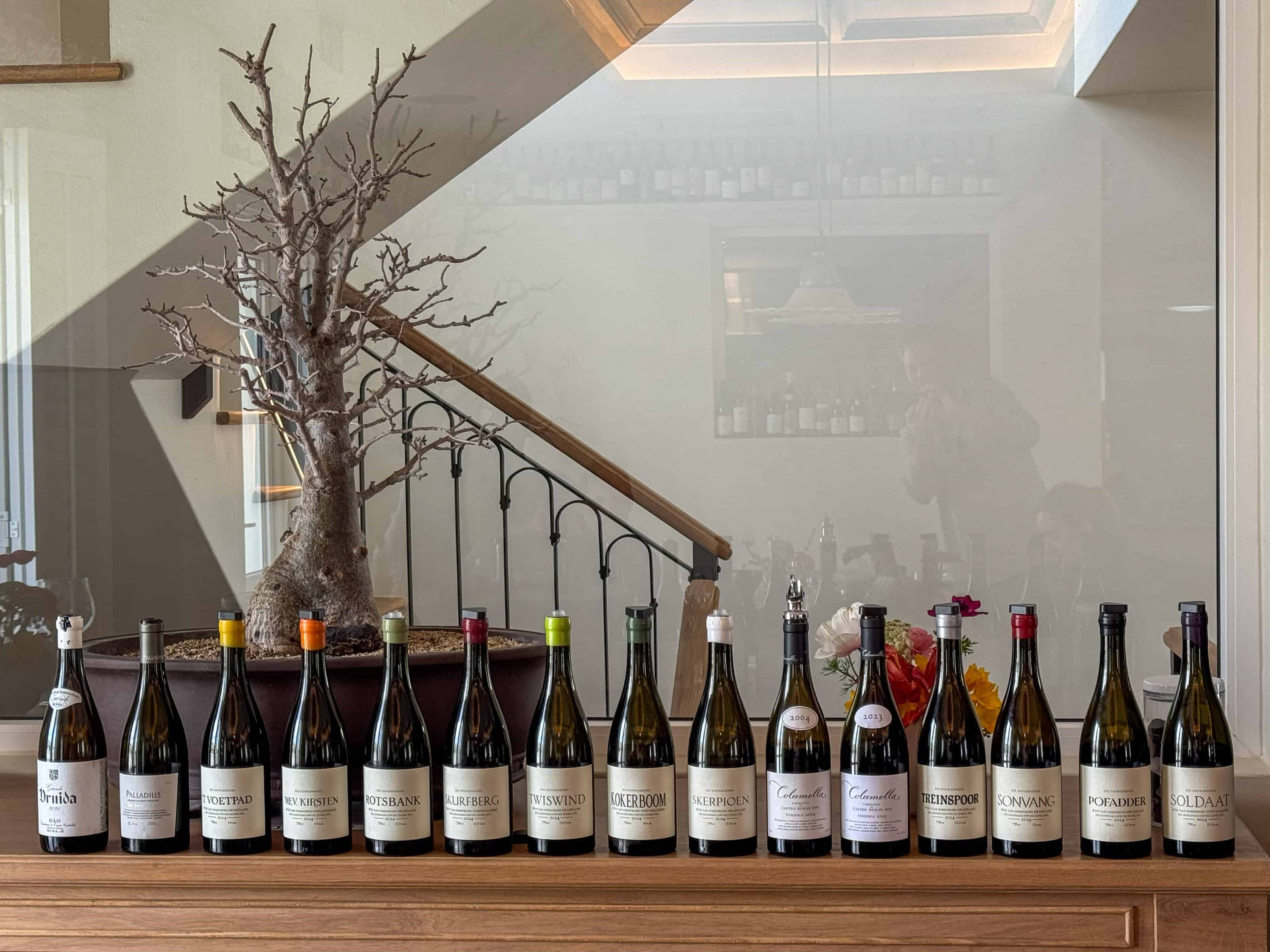
2024 The Sadie Family Wines “Skerpioen” White Blend, Swartland, Coastal Region, South Africa
Palest gold in the glass, this wine smells of freshly shucked oysters, lemon zest, and lime blossom. In the mouth, saline lime blossom, citrus pith, oyster shell, and pulverized stone flavors have incredible crystalline acidity, lift, and dynamism. Utterly delicious and nearly impossible not to swallow. A 50-50 blend of Chenin Blanc and Palomino grown on calcareous soils. 13.5% alcohol. Score: between 9.5 and 10. Cost: $87. click to buy.
2024 The Sadie Family Wines “Kokerboom” Semillon, Citrusdal Mountain, Olifants River, South Africa
Pale gold in the glass, this wine smells of lemon oil, lemon peel, and wet chalkboard. In the mouth, pure crystalline flavors of lemon peel, lemon oil, crushed stones, and sunlight have a gorgeous stony grip and chalky texture in the mouth, along with outstanding acidity. Very faintly saline with hints of bee pollen and acacia blossom lingering in the finish. Stunning. There are 5 ancient Semillon vineyards in the country, and this is one of them, with vines around 100 years old. 14% alcohol. Score: between 9.5 and 10. Cost: $86. click to buy.
2024 The Sadie Family Wines “Skurfburg” Chenin Blanc, Swartland, Coastal Region, South Africa
Pale gold in the glass, this wine smells of pear and pear skin, white flowers, and wet chalkboard. In the mouth, salty flavors of pear and crushed stones mix with grapefruit pith, a touch of nougat, flower pollen, and chamomile. The wine has fantastic acidity, an amazing crushed stone grip on the palate, and incredible length. Phenomenal. Grown in very dry sandstone soils at high elevation. 13.5% alcohol. 4000 bottles made. Score: between 9.5 and 10. Cost: $79. click to buy.
2024 The Sadie Family Wines “Twiswind” White Blend, Swartland, Coastal Region, South Africa
Pale gold in the glass, this wine smells of citrus pith, lemon peel, yellow flowers, and a hint of dried herbs. In the mouth, faintly saline flavors of citrus peel, citrus pith, crushed stone, and herbs have a lightly grippy, chalky texture and excellent acidity. There’s also a hint of green herbs in the finish. A field blend of Vermentino, Picpoul, Marsanne, Grenache Blanc, Cinsaut Blanc, Palomino, Chenin Blanc, Grillo, Assyrtiko, Verdelho, Clairette Blanche, and Semillon from one of Sadie’s new estate vineyards, his most wind-affected site. Twiswind means “to argue with the wind.” This is the first commercial bottling of this estate vineyard. 13.5% alcohol. Score: between 9 and 9.5. Cost: $93. click to buy.
2024 The Sadie Family Wines “T’Voetpad” White Blend, Swartland, Coastal Region, South Africa
Pale gold in the glass, this wine smells of lemon-scented quartz crystals, wet chalkboard, and oyster shell. In the mouth, salty flavors of lemon oil, wet pavement, pulverized stones, and white flowers have a lovely stony grip and gorgeous, crackling acidity. Flavors seem to linger and shimmer for a long time on the palate. A frankly jaw-dropping wine of unbelievable deliciousness. A blend of Semillon Blanc, Semillon Gris, Muscat, and Chenin Blanc grown on alluvial sandstone. This is the oldest coplantation of white grapes in South Africa, planted in 1878. 14% alcohol. 2200 bottles made each year. Score: around 10. Cost: $118. click to buy.
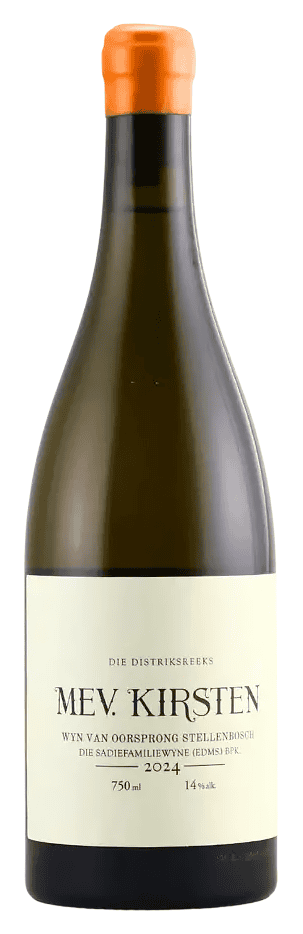
2024 The Sadie Family Wines “Mev. Kirsten” Chenin Blanc, Swartland, Coastal Region, South Africa
Pale gold in color, this wine smells of pear, lemon oil, pear skin, and white flowers. In the mouth, pear and white flowers, pear skin, and crushed stones are salty, stony, crystalline, and gorgeous. There’s a hint of green herbs and white flowers in the finish, but overall this wine conveys an impression of drinking liquid, scented stone, which tinkles like icicles thawing on a sunny winter’s day. Positively thrilling with incredible acidity. This is the oldest Chenin Blanc vineyard in South Africa, planted in 1905. 14% alcohol. Score: around 10. Cost: $175. click to buy.
2024 The Sadie Family Wines “Rotsbank” Chenin Blanc, Swartland, Coastal Region, South Africa
Pale gold in the glass, this wine smells of salty wet chalkboard and pear skin with just a hint of struck match. In the mouth, stony and salty citrus pith and unripe pear flavors mix with pear skin and crushed quartz crystals. Stunningly lean and crystalline with amazing acidity. Grown in blue granite on the Paardeberg, a very unusual site. Rotsbank means “rock shelf.” 13.5% alcohol. Score: around 9.5. Cost: $90. click to buy.
2023 The Sadie Family Wines “Palladius” White Blend, Swartland, Coastal Region, South Africa
Light gold in the glass, this wine smells of lemon peel, pear skin, nectarine, fynbos, and wet chalkboard. In the mouth, salty flavors of fynbos, lemon peel, grapefruit, dried herbs, nectarine, and a hint of white flowers have a weightlessness to them. This wine is deeply stony and wonderfully salty with a faint waxy character that lingers in the finish. Shimmering, crystalline, ethereal, and gobsmackingly tasty, with phenomenal acidity. Made from 16 different vineyards, all dedicated solely to this Palladius wine. A blend of Chenin Blanc, Grenache Blanc, Clairette Blanche, Viognier, Verdelho, Roussanne, Marsanne, Semillon Gris, Semillon Blanc, Palomino, Colombard, Grillo and Assyrtiko. For the first time in this wine, a small vineyard planted next to Skerpioen is being used for 20% of the blend, which is planted to Assyrtiko, Verdelho, Vermentino, Grenache Blanc, and Chenin Blanc, all grown in pure limestone. 13.5% alcohol. Score: around 10. Cost: $139. click to buy.
2024 The Sadie Family Wines “Soldaat” Grenache, Citrusdal Mountain, Olifants River, South Africa
Light ruby in the glass, this wine smells of wildflowers, sour cherries, fynbos, and strawberries. In the mouth, strawberry and herb flavors mix electrically with sour cherries, chopped green herbs, citrus peel, and wet stones. Saline and delicious. Fine-grained tannins hang gauzily in the background as incredible acidity makes for a seemingly endless finish. Gorgeous and mouthwatering. Grown in sandstone soils. 13.3% alcohol. Score: between 9.5 and 10. Cost: $74. click to buy.
2024 The Sadie Family Wines “Sonvang” Red Blend, Swartland, Coastal Region, South Africa
Medium garnet in the glass with ruby highlights, this wine smells of black tea, wildflowers, sour cherries, and raspberries. In the mouth, sour cherries, raspberries, dried herbs, fynbos, and black tea flavors are wrapped in a fleecy sheet of tannins that coat the mouth. Notes of fynbos herbs linger in the finish. Amazing acidity. A field blend of Alicante Bouschet, Agiorgitiko, Pontac, Bastardo do Castillo, Trincadera, Tinta Barocca, Lledoner Pelut, Grenache Noir, Pinotage, Cinsaut, Counoise, and Carignan. Sonvang means “sun catcher.” This is the first commercial bottling of this estate vineyard. 14% alcohol. Score: between 9 and 9.5. Cost: $86. click to buy.
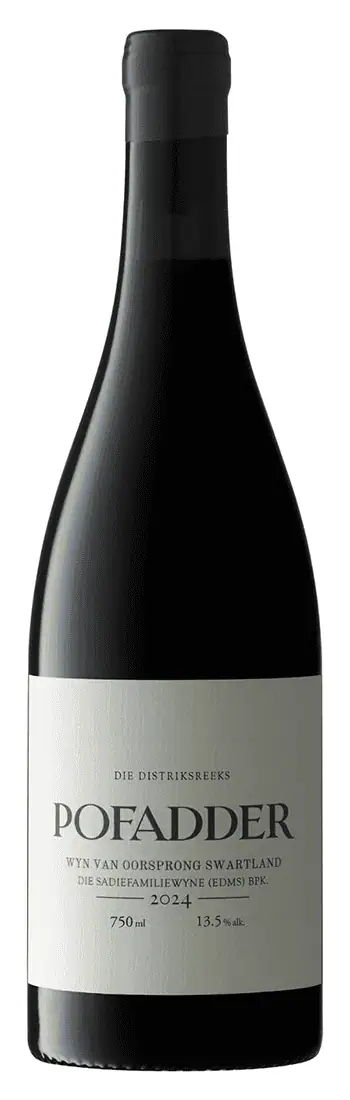
2024 The Sadie Family Wines “Pofadder” Cinsault, Swartland, Coastal Region, South Africa
Medium garnet with a hint of haze to it, this wine smells of sour cherry, dried herbs, and citrus peel. In the mouth, sour cherry and redcurrant flavors mix with citrus peel, lemon juice, and dried herbs. Gorgeous, bright, saline, and textured with gauzy tannins and fantastic acidity. Notes of fynbos linger in the finish. Wonderfully stony, aromatic and bright. 41-year-old vines planted on slate. 13.5% alcohol. Score: around 9.5. Cost: $83. click to buy.
2024 The Sadie Family Wines “Treinspoor” Tinta Barrocca, Swartland, Coastal Region, South Africa
Medium to dark garnet in the glass, this wine smells of black cherry, sour cherry, licorice, and chopped green herbs. In the mouth, fleecy tannins coat the mouth, while black cherry, plum, citrus peel, dried herbs, and pulverized stones vibrate with excellent acidity. Minty in quality, with chopped green herbs lingering in the finish. Mysterious and compelling. Planted in 1974 in alluvial soils. 13.1% alcohol. Score: around 9.5. Cost: $85. click to buy.
2023 The Sadie Family Wines “Columella” Red Blend, Swartland, Coastal Region, South Africa
Medium to dark garnet in the glass, this wine smells of violets, black cherries, blackberries, licorice, and blueberries. In the mouth, gorgeous, mouthwatering flavors of fynbos, wildflowers, mulberries, citrus peel, and licorice root are swirling and dynamic on the palate. Fresh, delicious, and saline, with just the barest hint of dashi-like umami and fantastic acidity. A blend of Syrah, Mourvèdre, Grenache, Carignan, Cinsaut, Tinta Barocca, and Pinotage. From 12 vineyards, 11 of which are solely dedicated to Columella. 13.5% alcohol. Score: between 9.5 and 10. Cost: $146. click to buy.
2004 The Sadie Family Wines “Columella” Red Blend, Swartland, Coastal Region, South Africa
Dark ruby in the glass, this wine smells of dates, raisins, chocolate, and licorice mixed with cherries and a hint of acetone that eventually morphs into wild floral and aromatic herb aromas. In the mouth, fleecy tannins wrap around a core of salty licorice and dried black cherries. Dried herbs and dried flowers linger in the finish. The wine is long and supple in the mouth, with excellent acidity remaining after 21 years. 14.5% alcohol. Score: between 9 and 9.5. Cost: $n/a