Given the state’s facility with Pinot Noir and Chardonnay above all others, one would think it only natural that Oregon would become a hotbed of sparkling-wine production. But for the first twenty years or so of the state’s winegrowing history, only a handful of producers tried their hands at sparkling wine. Now, however, there are more than 100 producers of sparkling wine in Oregon, and the most serious among them are organising under the banner of ‘Method Oregon’.
Much like South Africa’s Cap Classique organisation dedicated to promoting the local traditional-method sparkling wines, Method Oregon aims to market the category while at the same time establishing standards for what top-quality sparkling wine from Oregon might look like.
These are early days, with the organisation still filing its paperwork and many discussions still in progress around how it will be structured, and what exactly it will do. But the collective spirit that has always animated the Oregon wine industry underlies the group’s beginnings and, as my recent tasting of these wines suggests, they have much to be proud of.
Lonely beginnings
‘My usual joke is: what is the sound of one hand clapping in the forest?’, says Oregon sparkling pioneer Rollin Soles. ‘It was pretty lonely in the beginning.’
Soles came to Oregon in the late 1980s to found Argyle winery along with business partner Brian Croser of Petaluma Wines in Australia’s Adelaide Hills. While working with Croser in Australia for three years, Soles had the opportunity to take a deep dive into traditional-method sparkling wine, funded and guided by Champagne Bollinger’s investment in Petaluma.
Armed with that knowledge and experience, as well as Croser as a business partner, Soles returned to Oregon and set up shop in 1987, back when there were still only a handful of commercial wineries in the Willamette Valley.
‘When we arrived in the valley, everything was planted on its own roots, with wide spacing, and the vigour was extraordinary’, says Soles. ‘It was difficult to get ripening every year for still wine, so we naturally pivoted towards sparkling, because we knew that we could reliably ripen to that level year in and year out.’
Continue reading this article on JancisRobinson.Com.
This article teases my monthly column at JancisRobinson.Com, which is available only to subscribers of her website. If you’re not familiar with the site, I urge you to give it a try. It’s only $13.99/mo or $134.99 a year, and well worth the cost, especially considering you basically get free, searchable access to the Oxford Companion to Wine ($65) and maps from the World Atlas of Wine ($50) as part of the subscription costs. Click here to sign up.
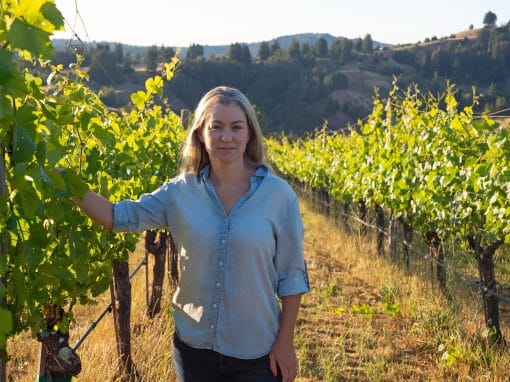
Photo of Lytle-Barnett’s Windfall vineyard in the Eola-Amity Hills by Lester Tsai.